檠
Character Story & Explanation
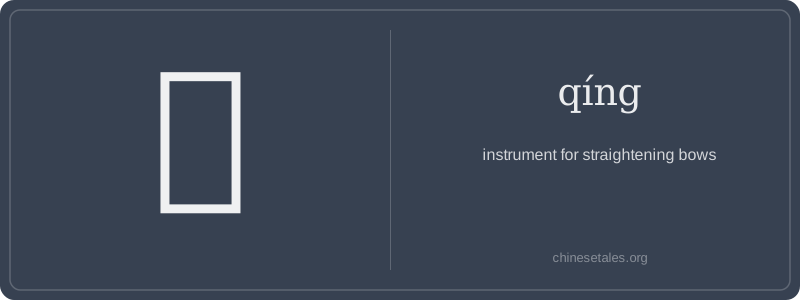
The earliest form of 檠 appears in bronze inscriptions from the Warring States period (475–221 BCE), where it depicted a vertical wooden frame (the 木 radical) holding a curved bow limb in place — often shown with two parallel horizontal strokes representing clamping bars, and a phonetic element suggesting pronunciation. Over centuries, the top simplified into 京 (jīng), which carried both sound and connotation of 'capital' or 'central structure' — hinting at its role as the central fixture in bow maintenance. By the Han dynasty, the current form stabilized: 木 on the left anchoring its material essence, 京 on the right providing phonetic grounding and structural symbolism.
This evolution mirrors its semantic journey: from a concrete, visible carpenter’s jig to a lexicalized term for any calibrated bow-shaping instrument. It appears in the *Zhou Li* (Rites of Zhou), describing royal armory procedures, and later in Tang dynasty military manuals, where proper use of 檠 was deemed vital for archery accuracy. Visually, the 16 strokes themselves mimic tension — the balanced weight of 木 (4 strokes) against the dense, upright 京 (12 strokes) evokes a sturdy frame holding pressure, just as the tool holds the bow’s curve.
Think of 檠 (qíng) as the ancient Chinese bowyer’s secret tool — not a weapon, but the quiet craftsman behind one. Its core meaning is deeply functional: a wooden device used to straighten or shape the arc of a bow, ensuring precision and power. The character feels archaic and technical, like finding 'trestle' or 'mandrel' in English — it names a specialized tool, not something you’d casually mention over dinner. You’ll almost never hear it in modern speech; it lives in classical texts, dictionaries, and historical reconstructions of ancient warfare or craftsmanship.
Grammatically, 檠 is a noun — always countable, never used as a verb or adjective. It takes no special particles, but appears with measure words like 一具 (yī jù, 'one piece/tool') or 一架 (yī jià). Example: '这具檠是用硬木制成的' (Zhè jù qíng shì yòng yìng mù zhì chéng de) — 'This bow-straightening tool is made of hardwood.' Note how it pairs naturally with nouns denoting construction material or function — never with verbs like 'use' alone without an object or context.
Culturally, 檠 embodies the Confucian ideal of *qiǎo* (craftsmanship) — the invisible mastery behind martial excellence. Learners often misread it as 'qíng' like 情 (emotion), leading to hilarious mental images of 'emotional bows'. Others confuse it with 青 (qīng, blue/green) due to the shared phonetic component. But remember: this character isn’t poetic — it’s pragmatic, precise, and quietly essential to the art of the bow.