檀
Character Story & Explanation
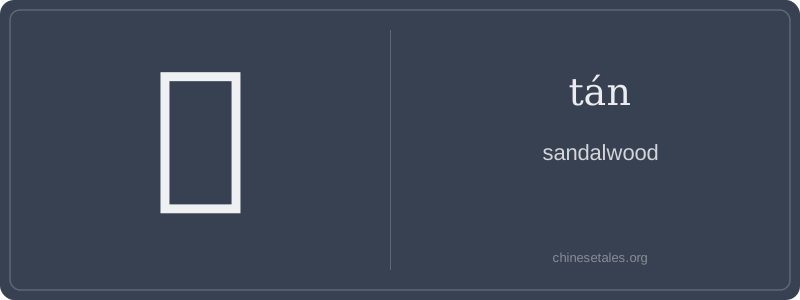
The earliest form of 檀 appears in Warring States bamboo slips — not as a pictograph, but as a clear semantic-phonetic structure: 木 on the left, and a variant of 暴 (originally depicting hands holding a sun over a rice field, later simplified) on the right. Over centuries, the right-hand component streamlined from a complex bronze-script form with sun (日), rice (米), and hands (廾) into today’s 暴-like shape — losing its agricultural meaning but preserving its role as a phonetic anchor. By the Han dynasty, the character stabilized: 17 strokes, balanced left-right, with the 木 radical firmly anchoring its identity as a type of tree.
Its meaning stayed remarkably consistent: by the 3rd century BCE, texts like the *Erya* (China’s oldest dictionary) define 檀 as 'a hard, fragrant, reddish wood used for carvings and ritual objects'. In Tang poetry, poets praised 檀 as 'the wood that breathes stillness' — linking its slow-burning incense to meditative clarity. The visual symmetry of the character — tall, upright, centered — mirrors the tree’s straight trunk and the cultural ideal of calm resilience. Even today, when calligraphers write 檀, they pause slightly before the final捺 (nà, 'sweeping stroke') — as if letting the scent settle.
檀 (tán) is first and foremost the elegant, aromatic heartwood of the sandalwood tree — but in Chinese, it’s never just botanical. It’s a scent that lingers in temples, a color that whispers sophistication (‘tan’-colored = warm reddish-brown), and a symbol of quiet dignity. The character itself is a semantic-phonetic compound: the left side 木 (mù, 'tree') tells you it’s wood-related; the right side 暴 (bào, originally pronounced *dàn* in Old Chinese) serves as the phonetic clue — though modern pronunciation has shifted to tán, the ancient sound link remains audible if you say ‘tán’ slowly with a soft ‘d’ hint.
Grammatically, 檀 rarely stands alone as a noun in modern speech — you’ll almost always see it in compounds like 檀香 (tánxiāng, 'sandalwood incense') or as part of proper nouns (e.g., 檀木家具, tánmù jiājù, 'sandalwood furniture'). Learners sometimes mistakenly treat it like a generic word for 'wood' — but no: it’s highly specific, culturally loaded, and almost always implies rarity, fragrance, and reverence. You wouldn’t say *‘wǒ yào yì kuài tán’* ('I want a piece of tán') — that sounds oddly poetic or archaic. Instead, you’d say *‘zhè ge xiānglú shì tánmù zuò de’* ('this incense burner is made of sandalwood').
Culturally, 檀 bridges religion and art: Buddhist monks burn tánxiāng to purify space and focus the mind; Ming dynasty craftsmen prized tánmù for its fine grain and enduring scent in scholar’s desks and zithers. A common mistake? Confusing it with the homophone 弹 (tán, 'to pluck' or 'bullet') — same sound, utterly different worlds. Also, don’t assume all ‘tan’-sounding words relate to wood: 檀 is exclusively botanical and noble — never explosive, never musical (unless it’s a sandalwood guqin!).