橎
Character Story & Explanation
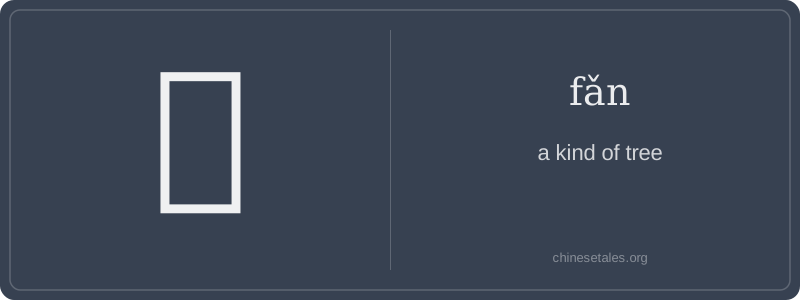
The character 橎 does not appear in oracle bone or bronze inscriptions — it’s a later creation, first reliably attested in the Eastern Han dynasty (25–220 CE) dictionary Shuōwén Jiězì. Its structure is entirely semantic-phonetic: the left radical 木 (mù, 'tree') anchors its meaning, while the right component 反 (fǎn, 'to turn over; contrary') serves as the phonetic clue — not a pictograph, but a clever sound-based borrowing. Over time, the 反 component evolved from an early seal-script form depicting a hand turning something upside-down into today’s streamlined shape, while 木 retained its classic three-stroke trunk-and-branches silhouette. No animal, no person — just wood + sound, forged in the scholarly heat of lexicography.
In classical usage, 橎 appeared in botanical glossaries and regional gazetteers describing southern Chinese flora — notably in texts referencing Guangdong and Fujian provinces, where such aromatic evergreens thrived. Though never a literary symbol like 梅 (plum) or 松 (pine), 橎 carried subtle prestige: its wood was said to resist rot and repel insects, making it ideal for coffins and ritual boxes — echoing Western associations of cedar with sanctity and preservation. The visual pairing of 木 + 反 subtly reinforces this: just as 'turning over' implies transformation and endurance, so too did 橎 wood 'turn back' decay. This quiet synergy between form, sound, and function is what makes 橎 a miniature masterpiece of linguistic engineering.
Think of 橎 (fǎn) as China’s botanical equivalent of the 'unicorn' — a real tree, but so rare in modern usage that it lives mostly in classical texts and dictionaries. It refers specifically to a type of evergreen tree (possibly related to the camphor or litsea family), valued in ancient times for its fine timber and aromatic wood — much like how Western herbalists once prized sandalwood or yew for carving sacred objects. Unlike common nouns like 树 (shù, 'tree'), 橎 is almost never used alone in speech; it appears only in scholarly, historical, or poetic contexts — like dropping 'sycamore' into conversation when you really mean 'maple'. You won’t hear it on the subway or in HSK dialogues.
Grammatically, 橎 behaves like any noun: it can be modified by adjectives (e.g., 古橎, 'ancient 橎 tree') or appear in compound words, but it never takes aspect markers (了, 过) or pluralizers (们). Learners sometimes mistakenly treat it as a verb because of its -ǎn ending (like 管 guǎn or 散 sàn), but no — it’s purely nominal, and tone 3 (fǎn) is non-negotiable. Mispronouncing it as fān or fàn instantly flags you as unfamiliar with classical botany.
Culturally, 橎 is a quiet relic of China’s rich pre-modern ecological vocabulary — a word that survived centuries of literary transmission but vanished from daily ecology as forests shrank and naming conventions shifted. Modern botanists rarely use it; instead, they cite Latin names like *Litsea cubeba*. The biggest learner trap? Assuming it’s interchangeable with 樟 (zhāng, 'camphor tree') — a tempting but botanically inaccurate shortcut. Respect the specificity: 橎 isn’t just any fragrant tree — it’s a particular one, preserved like pressed flora in ink and silk.