橁
Character Story & Explanation
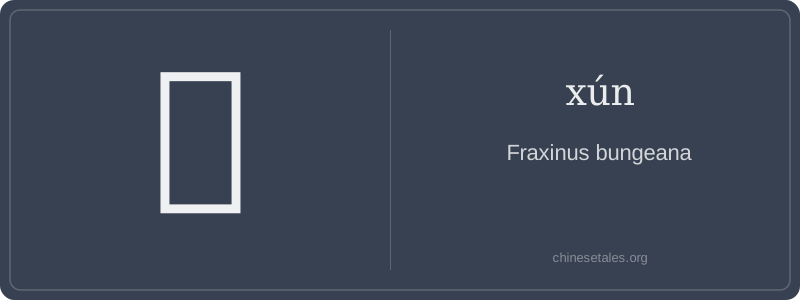
The earliest form of 橁 appears in late Warring States bamboo slips — not as a pictograph, but as a carefully constructed phono-semantic compound. The left side, 木 (mù, ‘tree’), was already standardized as a radical indicating botanical category. The right side, 尋 (xún), originally depicted a man stretching arms wide to measure length (寸 + 彐 + 又), later abstracted into a phonetic indicator. Scribes combined them around 300 BCE to create a character that *sounded like* xún while meaning ‘that specific ash tree’ — a pragmatic solution for naming local flora where no earlier character existed.
By the Tang dynasty, 橁 appears in Li Shizhen’s Bencao Gangmu (Compendium of Materia Medica) describing its bark’s use in treating wind-damp disorders — confirming its identity as Fraxinus bungeana, not the European ash. Crucially, the character never acquired metaphorical extensions (unlike 松 ‘pine’ for resilience or 梅 ‘plum’ for perseverance). Its form stayed rigid: 木 anchoring meaning, 尋 anchoring sound — a rare case of a Chinese character built purely for taxonomic clarity, not cultural symbolism.
Let’s crack 橁 like a botanist and a calligrapher rolled into one. First, the feel: this is a *hyper-specific* botanical character — not ‘tree’ or ‘wood’, but precisely Fraxinus bungeana, a native Chinese ash tree with tough, flexible wood historically used for tool handles and bows. It’s not abstract or poetic; it’s taxonomic, almost scientific — like finding ‘Quercus rubra’ in English text. You’ll rarely see it outside forestry reports, regional floras, or classical herbal texts.
Grammatically, 橁 functions exclusively as a noun — never a verb, adjective, or modifier. It doesn’t pluralize, doesn’t take aspect particles (了, 过), and almost never appears without a classifier or context clue. You won’t say ‘I saw an 橁’ — you’ll say ‘a stand of 橁 trees’ (一丛橁树) or ‘the bark of the 橁’ (橁树皮). Its usage is tightly bound to ecological or material specificity: think ‘ash wood’ (橁木) when discussing timber quality, not ‘ash’ as in the element.
Culturally, it’s a quiet relic: modern speakers often misread it as xún (like 寻) or even shùn (confusing the 又 component), and many dictionaries list it only in extended character sets (GBK, not GB2312). Learners shouldn’t memorize it for conversation — but spotting it in a nature reserve sign or a Song dynasty herbal manuscript? That’s a tiny, satisfying win. Mistake it for 林 (lín, ‘grove’) or 森 (sēn, ‘forest’), and you’ve swapped a single species for an entire ecosystem — a classic ‘precision vs. poetry’ trap.