樽
Character Story & Explanation
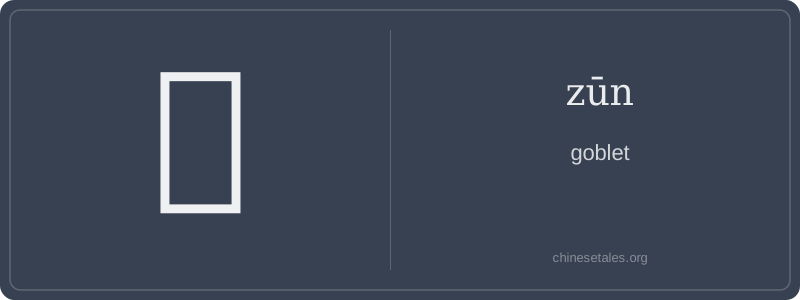
The earliest forms of 樽 appear in Warring States bamboo slips and Han dynasty seals — not as a pictograph of a cup per se, but as a clear composite: the left side 木 (wood) plus 口 (mouth-shaped opening) atop 八 (suggesting symmetrical flaring sides) and 木 again below — a stylized depiction of a tall, narrow, two-handled wooden vessel with a wide mouth and fluted base. Over centuries, the top 口 fused with 八 into 臽-like structure, and the dual 木 elements condensed into the modern left-radical 木 and right component 尊 (which itself evolved from a hand holding a vessel over a base). By the Tang dynasty, the shape stabilized into today’s 16-stroke form — elegant, vertical, and unmistakably crafted.
This evolution mirrors its semantic journey: from a concrete object (a specific type of lacquered wooden wine container used in Zhou dynasty rituals) to a literary symbol. In the Book of Songs, 樽 appears in banquet odes describing ancestral worship; by the Tang, Li Bai’s famous line ‘人生得意须尽欢,莫使金樽空对月’ (‘When life brings joy, revel fully — don’t let the golden goblet face the moon empty’) cemented 樽 as the vessel of poetic transience. Its enduring visual balance — wood supporting ceremony — makes it a quiet masterpiece of functional etymology.
At its heart, 樽 (zūn) is a poetic, slightly archaic word for a ceremonial wine goblet — not just any cup, but one carved from wood, often ornately decorated and reserved for banquets, rites, or literary toasts. It evokes elegance, ritual, and classical refinement — think bamboo groves, ink-washed scrolls, and poets raising cups under moonlight. Unlike everyday words like 杯 (bēi) or 碗 (wǎn), 樽 rarely appears in spoken Mandarin; you’ll find it almost exclusively in classical poetry, historical dramas, or formal written descriptions of antiquity.
Grammatically, 樽 functions as a countable noun, usually preceded by numerals or measure words like 只 (zhī) or 一樽 (yī zūn). It’s common in fixed literary phrases such as 一樽酒 (yī zūn jiǔ — 'a goblet of wine') or in parallel constructions like ‘举樽’ (jǔ zūn — 'to raise the goblet'), where the verb + 樽 pairing signals solemn or lyrical action. Learners sometimes mistakenly use it like a generic cup — but no: calling your coffee mug a 樽 would sound like calling a paper cup a Fabergé egg.
Culturally, 樽 carries Confucian and Daoist resonance: in poems by Li Bai or Du Fu, raising a 樽 isn’t about drinking — it’s about communion with nature, defiance of time, or quiet lament. A classic trap? Confusing it with 尊 (zūn, same pinyin) meaning 'respect' — identical pronunciation, wildly different meaning and radical (寸 vs. 木). Also, its wooden radical 木 isn’t decorative: ancient 樽 *were* carved from wood or lacquered wood — a detail that anchors the character in material reality, not abstraction.