樶
Character Story & Explanation
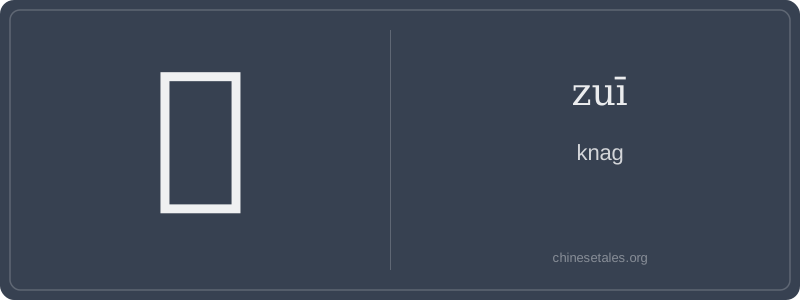
The earliest form of 樶 appears in late Warring States bamboo slips — not oracle bones, but inked script where scribes needed efficiency. Visually, it’s a radical fusion: the left side is 木 (mù, tree/wood), anchoring it in botany; the right is 取 (qǔ, to take), but heavily stylized — its upper stroke bends sharply downward like a twisted limb, while the lower strokes collapse into a jagged, angular cluster resembling fractured wood grain. Over centuries, clerical script smoothed the curves, but preserved that ‘broken-take’ shape — turning 取 into a visual pun: not ‘to take’, but ‘taken *by* force’ — as if the wood itself seized back control, erupting in defiance.
This semantic pivot is confirmed in the 12th-century *Jiyun* rhyme dictionary, which defines 樶 as ‘a knotted excrescence on old timber, especially on camphor or pine’. By the Ming dynasty, it appears in Lu Rong’s *Shuyuan Zaji*, describing temple rafters where ‘the master carpenter spared three 樶 on the central beam — each a record of lightning strikes endured’. The character’s form mirrors its meaning: the 木 radical grounds it, while the distorted 取 evokes both violence (the trauma that caused the knag) and agency (the tree’s slow, silent reclamation of shape).
Imagine you’re hiking through a misty, ancient forest in southern China — the kind where gnarled camphor trees twist skyward like petrified dragons. You reach out to steady yourself on a trunk and your palm catches on a sharp, knotted protrusion: not a branch, not bark, but a stubborn, twisted *knag* — hard, irregular, unyielding. That’s 樶 (zuī): not just any bump, but a *natural, woody excrescence* — the kind that forms where a branch died or was broken off long ago, leaving behind a dense, fibrous knot that resists carving, splitting, or even decay. It’s deeply tactile, almost geological in its stubbornness.
Grammatically, 樶 is almost never used alone — it’s a noun that appears only in compound words or technical/descriptive contexts, usually paired with terms like 木 (wood), 根 (root), or 瘤 (tumor-like growth). You won’t hear it in daily speech or see it in textbooks; it’s a lexical fossil preserved in forestry manuals, classical poetry describing aged trees, or regional dialects of Fujian and Guangdong. Learners often mistakenly treat it as a verb or try to use it like 柱 (pillar) or 桩 (stump) — but 樶 has zero productive grammar; it doesn’t take aspect particles, doesn’t combine with 了 or 过, and carries no abstract metaphorical weight (unlike 节, which means ‘node’ *and* ‘festival’).
Culturally, 樶 embodies *resilience through imperfection*: in Chinese woodcraft and fengshui, such knags aren’t flaws — they’re signs of endurance, sometimes deliberately left intact in scholar’s tables or garden sculptures to evoke age, wisdom, and unbroken continuity. Mistake it for 棕 (zōng, palm tree) or 森 (sēn, dense forest), and you’ll conjure entirely different landscapes — one tropical, one lush, neither knotty. Its rarity makes it a quiet testament to how precisely Chinese names nature’s irregularities.