樛
Character Story & Explanation
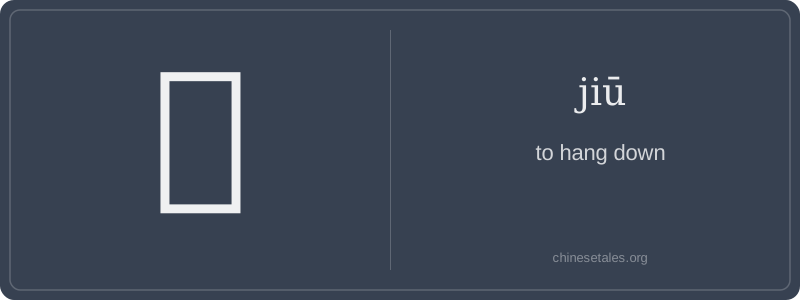
The earliest form of 樛 appears in bronze inscriptions as a vivid pictograph: a sturdy tree (木) on the left, and on the right, a sinuous, coiling line suggesting a vine or branch twisting downward and clinging — not falling, but *embracing* descent. Over centuries, the right-hand element simplified from a flowing curl into 赳 (a character originally depicting a marching warrior with raised arms), but scribes kept the visual echo of looping, hanging motion. By the seal script era, the two sides fused: the left 木 stayed grounded, while the right evolved into today’s 丩 + 口 + 夂 — a composition that looks like tangled stems descending step by step (the 夂 radical, meaning 'to go slowly downward', reinforces the meaning).
This character’s meaning stayed remarkably faithful across three millennia. In the Shijing, Ode 245 sings of '樛木' (jiū mù) — literally 'hanging-down trees' — symbolizing benevolent, sheltering virtue: just as vines drape softly over strong trunks, noble character supports others without dominance. The visual logic is profound: the character itself *hangs* — its lowest stroke (the 夂) dips below the baseline, mirroring its semantic core. Even its pronunciation jiū mimics a soft, drawn-out sigh — the sound of something yielding gracefully, not snapping.
Think of 樛 (jiū) not as a dry dictionary definition, but as a quiet, graceful gesture — like ivy spiraling down an old tree trunk or willow branches dipping to kiss still water. Its core meaning 'to hang down' isn’t just physical gravity; it’s about gentle, organic downward movement with softness and continuity. You won’t find it in daily chat or HSK textbooks because it’s literary, poetic, and almost botanical — it breathes in classical verse and descriptive prose, never in 'Where’s the bathroom?' conversations.
Grammatically, 樛 is almost always used as a verb in formal or literary contexts, often paired with nouns denoting flexible, climbing, or trailing things: vines, branches, banners, or even sorrow (in metaphorical expressions). It rarely stands alone — you’ll see it in phrases like 樛枝 (jiū zhī, 'twisted/hanging branches') or in parallel constructions in poetry. A common learner trap? Confusing it with the more common 勾 (gōu, 'to hook') or 交 (jiāo, 'to intersect') — but 樛 has no sharp angles or crossing lines; its essence is *curving surrender* to gravity, not grasping or joining.
Culturally, this character is a subtle nod to Chinese aesthetics valuing natural flow over rigidity — think of ink-painting willows or the elegant droop of temple eaves. It appears in the Shijing (Classic of Poetry), where it evokes harmony between human emotion and the bending, yielding beauty of nature. Learners often misread its radical — yes, it’s 木 (tree), but the right side isn’t 糾 (jiū, 'to untangle'); it’s actually 赳 (jiū, archaic 'to march boldly'), repurposed here for sound, not sense — a classic case of phonetic borrowing that makes it extra tricky!