樆
Character Story & Explanation
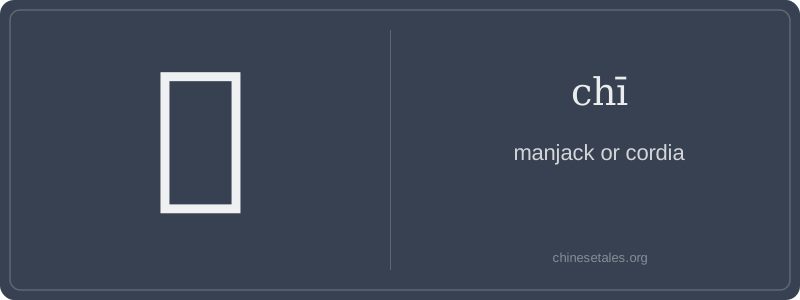
The earliest form of 樆 isn’t found in oracle bones (too rare for such a specific plant), but its structure tells a clear story. The left side 木 (mù) is the ‘tree’ radical — unchanged since bronze inscriptions, always anchoring botanical characters. The right side is 离 (lí), originally a pictograph of a bird (隹) perched atop a nest (厶 + 厶), later stylized into its modern shape. Over centuries, scribes merged the two components: 木’s clean vertical stroke stabilized the left, while 离’s intricate upper strokes ( + 丨 + + 丶) condensed into today’s compact right half — 14 strokes total, each echoing leaf, branch, and blossom.
This character first appeared reliably in the *Bencao Gangmu* (Compendium of Materia Medica, 1596), where Li Shizhen documented 樆’s cooling properties and use in treating sore throats. Its pairing of 木 (nature) and 离 (phonetic hint — ancient *lí* sound, later shifting to chī under dialectal influence) reflects how Chinese lexicographers named plants: combine meaning + sound. Interestingly, the ‘departure’ sense of 离 was never borrowed — 樆 stays firmly rooted in the earth, its name a tribute to fragrance, not farewell.
Meet 樆 (chī) — a botanical deep-cut that’s as specific as it is serene. It refers exclusively to the manjack tree (Cordia dichotoma), a small deciduous tree native to East and South Asia, prized for its fragrant white flowers, edible fruit, and medicinal bark. Unlike generic terms like 树 (shù, 'tree'), 樆 names *one* precise species — think of it like using 'ginkgo' instead of 'tree' in English: precise, slightly scholarly, and quietly poetic. You won’t hear it in daily chat, but you *will* spot it in classical herbals, regional floras, or poetic descriptions of spring groves.
Grammatically, 樆 behaves like any noun: it appears after measure words (e.g., 一棵樆, yī kē chī — 'one manjack tree') or modifies other nouns (e.g., 樆花, chī huā — 'manjack flower'). Crucially, it’s *not* used as a verb or adjective — no 'to manjack' or 'manjack-like' here! Learners sometimes misread it as a variant of 离 (lí, 'to depart') due to visual similarity, but that’s a classic trap: 樆 has wood (木) on the left — it’s rooted in botany, not separation. Also, while 樆 *can* be pronounced lí in rare historical transcriptions (e.g., archaic phonetic loan usage), that reading is obsolete outside specialized philological contexts — stick with chī unless your professor hands you a Song-dynasty manuscript.
Culturally, 樆 carries quiet elegance. In Tang poetry and Ming herbal texts, it symbolizes gentle resilience — blooming early despite cool spring winds, its fruit nourishing yet unassuming. Modern learners rarely encounter it, which makes spotting it feel like finding a pressed flower in an old dictionary: delicate, meaningful, and deeply rewarding when you get it right.