桩
Character Story & Explanation
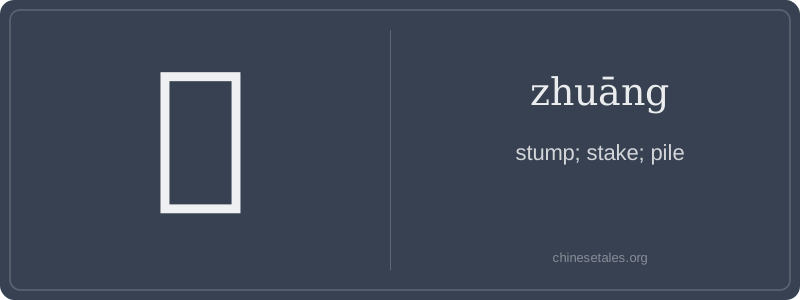
The earliest form of 桩 appears in Han-dynasty clerical script as a clear fusion: 木 (mù, 'tree') on the left, and 壮 (zhuàng, 'strong, robust') on the right — not as a phonetic loan at first, but as a semantic intensifier: 'a tree made strong by being cut short and left firm in the ground'. The bronze inscriptions didn’t feature it directly, but related characters like 杖 (zhàng, 'cane') and 柱 (zhù, 'pillar') share this logic of vertical wooden solidity. Over centuries, 壮 simplified visually: its top 口 became two horizontal strokes, its 下 (xià) component fused into the lower right, yielding today’s compact 10-stroke form — still unmistakably 'wood + strength-in-stasis'.
This visual logic shaped its meaning evolution: from concrete 'tree stump' (as seen in Tang poetry describing abandoned orchards), to 'driven pile' in Song-era canal construction texts, then metaphorically to 'a settled matter' — because a pile driven deep doesn’t move. By the Ming dynasty, legal manuals routinely used 一桩 to mark each recorded case, treating each as an immovable fact, like a post hammered into earth. Even today, saying 一桩误会 (yī zhuāng wùhuì, 'a misunderstanding') subtly frames it as something tangible, lodged — not fleeting.
Imagine walking through a forest after a storm — you spot a weathered tree stump, solid and unyielding, its grain exposed like a fossilized heartbeat. That’s 桩 (zhuāng): not just 'stump', but the *idea of rootedness* — something planted, anchored, or left behind as evidence of force or function. It carries weight, stability, and quiet persistence. In modern usage, it’s rarely abstract; it shows up where things are physically fixed (a fence stake), structurally essential (a bridge pile), or even metaphorically foundational (a 'case' or 'incident' — as in 一桩事). It’s always countable: you say 一桩 (yī zhuāng), never *zhuāng* alone.
Grammatically, 桩 is a measure word-like noun that pairs with 一 (yī) to quantify discrete, often consequential events or objects — especially legal, technical, or physical ones. You’ll hear 一桩案子 (yī zhuāng ànzi, 'a case'), 一桩买卖 (yī zhuāng mǎimài, 'a deal'), or 一桩心事 (yī zhuāng xīnshì, 'a worry'). Crucially, it’s *not* used for natural, unprocessed stumps — for those, people say 树桩 (shùzhuāng) or just 桩子 (zhuāngzi) colloquially. Learners often overgeneralize it to any 'thing' — but 桩 implies gravity, not triviality.
Culturally, this character quietly anchors bureaucratic and legal language: in official documents, 一桩事 sounds more formal and weighty than 一件事. Its wood radical (木) reminds us that its roots are literal — yet its modern life is almost entirely metaphorical. A common slip? Writing 桩 instead of 桩子 (zhuāngzi) when meaning 'stake' casually — but 桩 alone feels stark, technical, or literary, like a term borrowed from engineering blueprints or Ming-dynasty court records.