槺
Character Story & Explanation
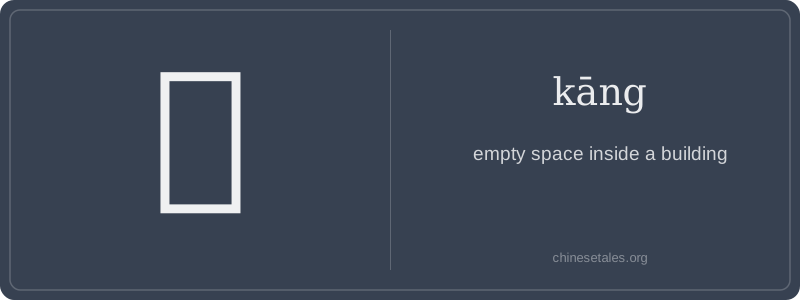
The earliest form of 槺 isn’t found in oracle bones — it emerged later, during the Warring States period, as a specialized character for timber architecture. Its left side 木 (mù, 'tree/wood') anchors it firmly in carpentry, while the right side 康 (kāng) originally depicted a grain storage vessel with an open top and wide base — a visual metaphor for containment with interior volume. Over centuries, clerical script streamlined the vessel shape into the modern 康 component, and the full character solidified into its current 15-stroke form: 木 + 康, literally 'wooden container-space' — a vivid fusion of material and void.
This duality shaped its meaning: by Han dynasty texts, 槺 described the central, unobstructed space beneath roof beams in ancestral halls — where incense smoke rose, voices echoed, and ritual breath met wood grain. It appears subtly in Tang poetry describing palace courtyards and Ming dynasty building manuals specifying 'beam spacing to enhance the 槺'. Crucially, its shape mirrors its meaning: the wide, open 'mouth' radical inside 康 visually echoes the hollow it names — making 槺 a rare character whose very strokes map the architecture it describes.
Think of 槺 (kāng) as the architectural equivalent of 'the hollow in a chocolate Easter bunny' — not the bunny itself, not the wrapper, but that deliberate, resonant emptiness inside. In Chinese, it doesn’t mean 'empty' in the abstract sense (like 空 kōng), nor does it describe vacancy or absence; rather, it’s a highly specific, almost tactile term for the *enclosed void* within a structure — the cavernous interior space of a hall, pavilion, or ancient timber-framed building. It carries weight and atmosphere: imagine standing under the soaring rafters of a Song-dynasty temple — 槺 is the word that hums in your throat as you feel that volume breathe around you.
Grammatically, 槺 is almost never used alone. It appears almost exclusively in literary compounds like 槺梁 (kāng liáng, 'hollow beam') or 槺廈 (kāng shà, 'spacious hall'), where it modifies nouns to emphasize structural openness and acoustic resonance. You won’t hear it in daily speech — no one says 'this room is 槺' — and attempting to use it like 空 ('empty') will sound jarringly archaic or poetic, like saying 'the chamber doth gape' at a coffee shop.
Culturally, 槺 reflects classical Chinese architecture’s reverence for negative space — not as lack, but as active presence. Learners often misread it as a variant of 康 (kāng, 'health') or 慷 (kāng, 'generous') due to shared pronunciation and stroke count, but those characters belong to entirely different semantic families (radical 广 vs. 忄). The biggest trap? Assuming it’s interchangeable with 空 — but while 空 can mean 'sky', 'vacuum', or 'emptiness of mind', 槺 is stubbornly, beautifully architectural: it’s the silence *between* the beams.