槲
Character Story & Explanation
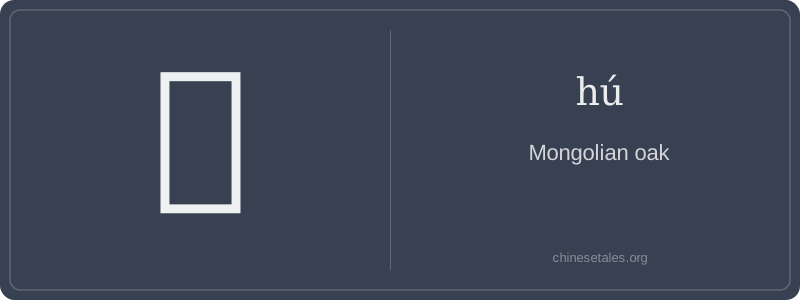
The earliest form of 槲 appears in seal script (zhuànshū), where it clearly combines 木 (mù, 'tree') on the left — unmistakably a stylized trunk with branching limbs — and 句 (jù/hú) on the right, which originally depicted a bent hook or curved object (think of an ancient bronze wine vessel’s handle). Over centuries, 句 evolved phonetically: its shape simplified, but its sound value stabilized as hú — a perfect match for the tree’s local name. By the Tang dynasty, the character had settled into its current structure: 木 + 句, 15 strokes total, with the right-hand component losing its pictorial hookiness but gaining tonal precision.
This visual marriage wasn’t arbitrary: 句’s curve subtly echoes the Mongolian oak’s distinctive leaf shape — broad at the base, tapering into a long, slightly hooked tip. Classical texts like the *Bencao Gangmu* (Compendium of Materia Medica) list 槲皮 (hú pí, 'Mongolian oak bark') for tanning and dyeing, reinforcing its practical, grounded identity. Unlike lofty pine or auspicious plum, 槲 never became a Confucian virtue symbol — instead, it quietly persisted in forestry records and folk medicine, its meaning unchanged for over a millennium: specific, resilient, unflashy.
Think of 槲 (hú) as China’s answer to the English word 'oak' — but with a twist: it doesn’t mean oak in general, only the *Mongolian oak* (Quercus mongolica), a hardy, drought-resistant tree native to northern China, Korea, and Japan. Unlike generic terms like 树 (shù, 'tree') or even 橡 (xiàng, 'oak' in modern botanical contexts), 槲 is deeply regional and ecological — it evokes misty mountains of Liaoning, rustling autumn forests near the Great Wall, and the quiet dignity of ancient woodlands that never made it into Western botany textbooks. It’s not abstract; it’s rooted — literally.
Grammatically, 槲 almost never stands alone in speech or writing. You’ll see it only in compound nouns (like 槲树 or 槲叶), or in poetic or scientific contexts. Learners sometimes try to use it like a verb ('to oak-ify something?') or mistakenly pair it with common measure words — but no: it’s strictly a noun, always modified or embedded. Its tone (hú, second tone) is soft and rising — like the gentle unfurling of a new leaf — so mispronouncing it as hǔ (third tone) risks sounding like 'tiger' (虎), which is *very* different from a stately deciduous tree.
Culturally, 槲 carries subtle literary weight: Tang and Song poets used 槲叶 (hú yè, 'Mongolian oak leaves') to symbolize rustic resilience or humble endurance — think of Du Fu quietly noting them beside a mountain hermitage. Modern learners often overgeneralize it to all oaks, but Chinese botanists distinguish sharply: 槲 ≠ 橡 ≠ 栎. Confusing them is like calling a maple a birch because both have lobed leaves — technically plausible, botanically inaccurate.