槃
Character Story & Explanation
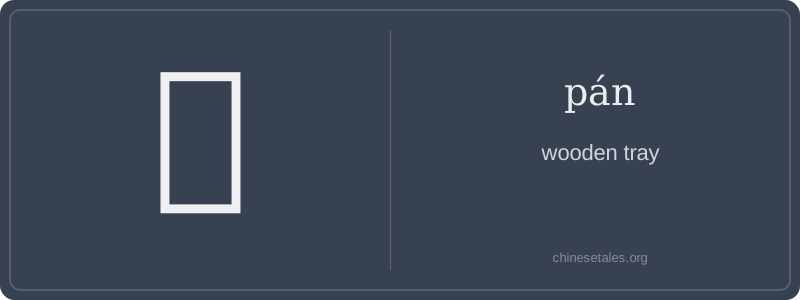
The earliest form of 槃 appears in bronze inscriptions from the Western Zhou period (~1000 BCE) as a pictograph showing a rectangular wooden board supported by two short legs—visually echoing the modern character’s structure: the 木 (wood) radical on the left, and the right side 叛 (bàn), which originally depicted a flat surface with stabilizing crossbars. Over centuries, the legs morphed into the 又 (hand) and 卩 (kneeling figure) components, then stylized further into the modern 叛—though today it’s purely phonetic, hinting at the sound pán. The 14 strokes map neatly: 木 (4) + 叛 (10), with the latter’s top horizontal stroke anchoring the whole frame like a tray’s rim.
By the Warring States period, 槃 had solidified as a term for ceremonial wooden trays used in banquets and sacrifices. Mencius references a ‘jīn pán’ (golden tray) symbolizing moral integrity—what one places before elders reflects one’s virtue. Its meaning never broadened to metal or ceramic; it stayed stubbornly wooden, a testament to early Chinese material culture’s reverence for timber. Even in Tang poetry, 槃 appears only when describing lacquered trays bearing peaches of immortality—not everyday dishes. The character’s visual weight—the balanced symmetry, the grounded 木—mirrors its cultural role: unassuming, essential, quietly authoritative.
Imagine a quiet Song dynasty tea ceremony in a scholar’s studio: bamboo curtains sway, incense curls, and the host lifts a smooth, lacquered wooden tray—pán—to present steaming bowls of matcha. This isn’t just any tray; it’s a vessel of ritual, balance, and quiet dignity. In Chinese, 槃 means ‘wooden tray’—but not the flimsy kind from your dorm kitchen. It evokes sturdy, hand-carved wood, often lacquered or inlaid, used for serving food, holding ritual objects, or even as a base for calligraphy brushes. You’ll rarely see it in daily spoken Mandarin (hence its absence from HSK), but it lives on in literary, historical, and artistic contexts.
Grammatically, 槃 is a noun that almost always appears with a classifier like yī gè (one [CL]) or yī fāng (one square)—e.g., yī fāng mù pán (a square wooden tray). It doesn’t function as a verb or adjective, and unlike generic words like pánzi (plate/bowl, colloquial), 槃 carries an air of formality and antiquity. Learners sometimes overuse it thinking it’s a neutral synonym for ‘plate,’ but that’s like calling a porcelain teacup a ‘chalice’ at Starbucks—it’s technically possible, but contextually jarring.
Culturally, 槃 is deeply tied to Confucian aesthetics: modesty, harmony, and functional beauty. In classical texts like the Rites of Zhou, specific types of 槃 were mandated for ancestral rites—carved with cloud motifs or inscribed with auspicious characters. A common mistake? Confusing it with 盘 (pán), the simplified form used for ‘plate’ or ‘disk’ (like hard disk). But 槃 is *only* traditional, literary, and wood-specific—no electronics, no takeout containers. Its rarity makes it a subtle marker of linguistic sophistication.