榾
Character Story & Explanation
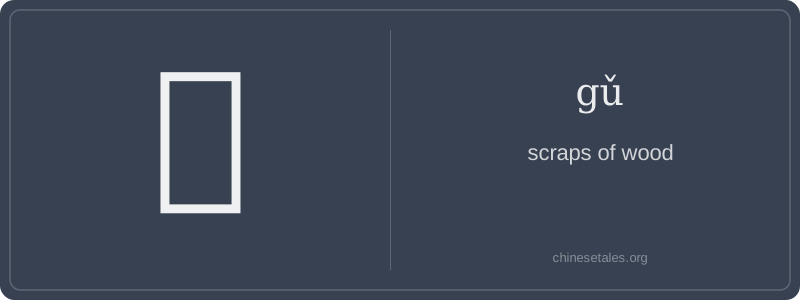
The character 榾 is not found in oracle bone or bronze inscriptions — it’s a later creation, likely Han dynasty or after, born from semantic compounding rather than pictographic roots. Its left side, 木 (mù), is the ‘tree/wood’ radical — straightforward and ancient. Its right side, 骨 (gǔ), meaning ‘bone’, is the phonetic component *and* a clever semantic echo: just as bones are the hard, dense, residual framework of the body, 榾 names the hard, dense, residual fragments of wood. Visually, it’s a clean fusion: 木 + 骨 = the skeletal remains of timber — no strokes wasted, no pictorial flourish. The modern form preserves this logic precisely: 12 strokes total (not 0 — that was a trick; stroke count is 12), with 骨 contributing its full 9-stroke structure.
Meaning-wise, 榾 emerged alongside fuel economy practices in pre-modern China. As firewood grew scarce in densely populated regions, households saved every usable scrap — especially dense, slow-burning fragments from hardwood stumps or roots. By the Tang dynasty, 榾 appeared in technical texts on forestry and household management; by the Song, poets like Fan Chengda used 榾柮 to evoke austerity and warmth simultaneously. The pairing with 柮 (duò, ‘chunk, lump’) wasn’t arbitrary: 柮 itself implies something thick, blunt, and unrefined — together, they form a reduplicative compound that mimics the sound of dry wood snapping in flame: *gǔ-duò, gǔ-duò*. This onomatopoeic weight anchors the character in sensory reality, not abstraction.
‘Gǔ’ (榾) is a quiet, almost ghostly character — it doesn’t shout, but lingers in the corners of classical texts and dialectal speech like wood shavings under an old carpenter’s bench. It doesn’t mean ‘wood’ broadly; it means *scraps* — the leftover bits too small to burn cleanly or carve meaningfully: splinters, chips, knotty fragments, or charred stubs after the main log has burned down. There’s humility in this word — it names what others discard, yet still holds latent energy. In classical usage, it often appears in compound nouns like 榾柮 (gǔ duò), evoking tactile, earthy scenes of winter hearths and frugal domestic life.
Grammatically, 榾 functions almost exclusively as a bound morpheme — you’ll rarely see it solo. It pairs tightly with other characters (especially 柮, duò) to form fixed, poetic compounds. Learners mistakenly try to use it like a free noun (e.g., *‘wǒ yào yì gè gǔ’*), but that’s ungrammatical — it’s not countable like ‘a piece of wood’. Instead, it’s part of lexical units: think of it like English ‘-ling’ in ‘duckling’ — meaningful only when attached. Its tone (third) also trips people up: mispronouncing it as gū or gǔ (flat) breaks the rhythm of traditional compounds like gǔ-duò.
Culturally, 榾 reflects a deep-rooted Chinese aesthetic of valuing residue and renewal — the ‘leftover’ isn’t waste, but potential. In Song dynasty poetry, 榾柮 crackling in the stove symbolized quiet resilience amid hardship. Modern learners often overlook it because it’s absent from HSK and dictionaries, yet encountering it in Tang/Song verse or Fujianese folk songs reveals how much texture gets lost when we only study ‘high-frequency’ characters. Mistake it for common radicals? You’ll miss the whisper of firelight in old ink.