榻
Character Story & Explanation
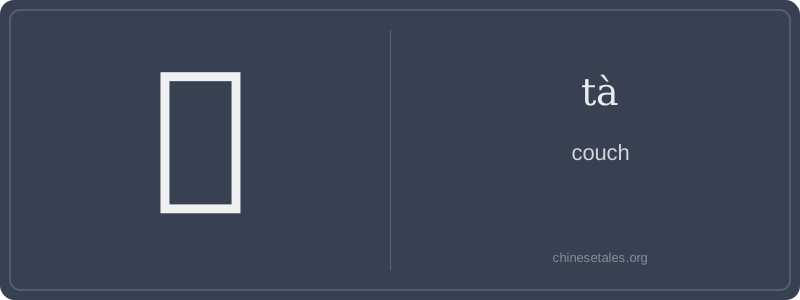
The earliest form of 榻 appears in Han dynasty clerical script, not oracle bones — it’s too late for that era. Its structure is deliberately architectural: the left 木 (wood) is stable and grounded, while the right side evolved from the ancient character 褯, which originally depicted folded cloth or layers — suggesting something spread out horizontally for resting. Over centuries, strokes simplified: the top part of 褯 condensed into two horizontal lines and a dot, the middle became a compact '衣' (yī, clothing) variant, and the bottom stabilized into '日' (rì, sun) — though here it’s purely phonetic, contributing the tà sound, not solar meaning. By the Song dynasty, the character had settled into its current 14-stroke form: balanced, symmetrical, and quietly sturdy — just like the furniture it names.
This character didn’t just name furniture — it named a cultural posture. In classical texts like the *Book of Rites*, the 榻 was specified for 'receiving honored guests without full ceremony' — a step down from the formal mat, but still dignified. When Cao Cao famously said '天下英雄唯使君与操耳' while sharing a meal on a shared 榻, the low couch signaled intimacy and equality — no throne, no hierarchy, just two men sizing each other up. Its visual calm — wood + horizontal spread — mirrors its semantic role: a surface for pause, reflection, and human-scale connection. Even today, when a designer chooses a 'Tà-style lounge', they’re invoking not just shape, but silence, intention, and unspoken respect.
At its heart, 榻 (tà) is a quiet, elegant word for a low, simple couch — not the plush Western sofa, but a traditional Chinese wooden platform for sitting or reclining, often in scholarly or poetic settings. It carries a whiff of classical refinement and understated dignity: think ink-washed paintings of scholars napping on a bamboo-lined veranda, not Netflix binges on a sectional. The character itself is built like a piece of furniture: the 木 (mù) radical on the left shouts 'wood' — no surprise, since most ancient 榻 were carved hardwood frames — while the right side 褯 (tà) is a phonetic component that also subtly hints at 'spreading out' or 'unfolding', evoking how one stretches out comfortably on it.
Grammatically, 榻 is almost always a noun and rarely used alone; it appears in fixed compounds (like 床榻) or with modifiers (e.g., 一张榻). You won’t say 'I sit on the tà' — instead, you’d say 他斜倚在紫檀榻上 (He reclines on the rosewood couch). Learners sometimes overuse it as a generic 'couch' — but in modern Mandarin, 沙发 (shāfā) dominates daily speech. 榻 survives mainly in literary, historical, or interior-design contexts — using it in casual chat about your IKEA couch would sound oddly archaic, like saying 'thou' at a coffee shop.
Culturally, 榻 blurs the line between bed and seat: in pre-Tang China, it served both functions — sleeping, receiving guests, even writing poetry. That duality explains why it appears in famous lines like Tao Yuanming’s '抚孤松而盘桓,倚南窗以寄傲' — where the implied 榻 beneath him anchors his quiet defiance. A common mistake? Confusing it with 床 (chuáng, 'bed') — but while 床 is broad and functional, 榻 is specific, lower, and steeped in literati aesthetics. It’s less 'where you sleep' and more 'where you contemplate life, preferably with tea.'