榥
Character Story & Explanation
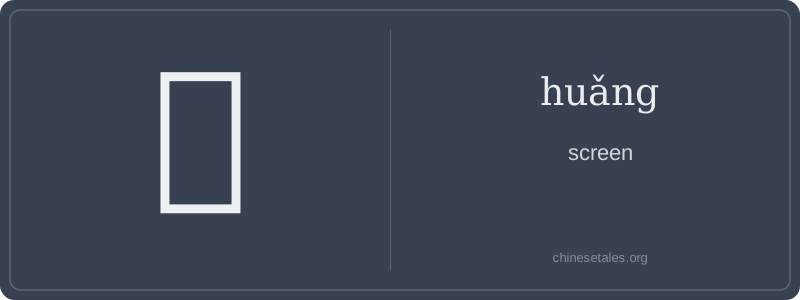
The earliest trace of 榥 appears not in oracle bones but in late Warring States bronze inscriptions and Han dynasty steles, where it evolved from a compound pictograph: left side 木 (‘tree/wood’) + right side 各 (originally a pictograph of a foot stepping *down onto* something — later phonetic). The ‘wood’ radical signals materiality; ‘各’ was borrowed for sound (gè → huǎng via dialectal shift and tone change). Visually, the modern form retains the wooden frame (木) anchoring the intricate internal structure — the four horizontal strokes and two verticals in the right component subtly echo intersecting laths or grillework.
By the Tang and Song dynasties, 榥 solidified as the term for fixed, ornamental wooden partitions — especially the lattice panels set into doors and windows of elite residences and temples. In the *Yingzao Fashi* (1103 CE, China’s first architectural manual), 榥 appears in technical diagrams specifying grid spacing and carving motifs. Its meaning never broadened to electronics or media — that semantic leap belongs to 屏幕. Instead, 榥 stayed rooted in craftsmanship: a character whose very strokes map the geometry of light-filtering woodwork.
Imagine walking into a Song dynasty scholar’s studio: sunlight slants through a delicate wooden lattice, casting shifting geometric shadows across ink-washed scrolls — that lattice is a huǎng. Not just any screen: 榥 evokes something elegant, semi-transparent, architectural — a partition that filters light and sight without sealing space. It’s not the heavy folding screen (屏风 píngfēng) nor the modern digital ‘screen’ (屏幕 shānpíng). Think bamboo blinds, carved wooden grilles in classical gardens, or ornamental window lattices — objects defined by patterned openness.
Grammatically, 榥 is almost exclusively a noun and appears mainly in literary, historical, or architectural contexts. You won’t hear it in daily chat; it’s found in phrases like ‘花窗槅’ (flower-patterned window huǎng) or ‘槅扇门’ (huǎng-panel door). Crucially, it’s never used alone as a verb — unlike ‘screen’ in English (*to screen a film*), 榥 has no verbal usage. Learners sometimes misread it as 屏 or 棂, but those carry different structural connotations: 屏 implies full occlusion; 棂 refers strictly to thin vertical window bars, not the whole framed lattice unit.
Culturally, 榥 embodies the Chinese aesthetic of *yǐn* (concealment) and *tòu* (transparency) — revealing only what invites contemplation. Mistaking it for a generic ‘screen’ misses its quiet poetry: it’s not about blocking, but about mediating — between inside and outside, light and shadow, public and private. Its rarity in spoken Mandarin means encountering it feels like finding a carved token from a vanished world.