榃
Character Story & Explanation
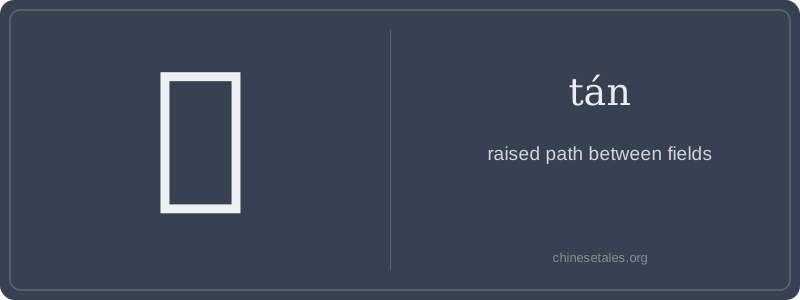
The earliest form of 榃 isn’t found in oracle bones — it’s a later regional creation, likely emerging in the Tang–Song period as Cantonese and Hakka speakers needed a precise way to write their landscape. Visually, it fuses two clear elements: the 木 (mù, tree/wood) radical on the left — signaling something built, constructed, or enduring — and the right side, 谭 (tán), which originally depicted water pooling around a mound (the 'yán' component hinting at containment, the 'shuǐ' radical implied). Over time, the water element simplified, leaving 谭 as a phonetic anchor while the wood radical grounded it literally: wooden stakes reinforcing an earthen ridge.
By the Ming dynasty, 榃 appears in local gazetteers describing irrigation layouts in Guangdong and Guangxi. Classical texts avoid it — Confucian scholars wrote about ritual altars (坛), not farm paths. Yet its visual logic is brilliant: 木 + 谭 = something man-made (wood) holding back or defining water (tan), creating dry passage. In poetry or folk songs, 榃 evokes quiet labor — the uncelebrated spine of agrarian life. Even today, if you walk a rural path in Foshan marked ‘榃口’, you’re treading a word that’s both map and memory.
Picture a sun-baked Guangdong countryside: narrow, earthen ridges winding between flooded rice paddies — not roads, not paths, but functional raised walkways farmers tread barefoot to tend crops without sinking. That’s the soul of 榃 (tán): a hyper-local, topographic noun meaning 'raised path between fields', used almost exclusively in southern China, especially in place names and dialectal speech. It carries no abstract or metaphorical weight — it’s purely geographical, earthy, and tactile.
Grammatically, 榃 is a noun that rarely appears alone in modern Standard Mandarin; you’ll find it embedded in village names (e.g., 黄猄榃), or occasionally in descriptive phrases like '田榃' (tián tán) — though even that is rare outside dialect contexts. Learners won’t encounter it in textbooks or exams (it’s absent from HSK), and attempting to use it conversationally in Beijing will likely draw blank stares. Its syntactic life is quiet, rooted, and regional — think of it as linguistic terroir.
Culturally, 榃 reveals how Chinese writing preserves micro-geographies invisible to national maps: it encodes centuries of wet-rice cultivation logic into a single character. A common mistake? Assuming it’s related to ‘tan’ words like 摊 (to spread) or 痰 (phlegm) — phonetic coincidence only. Also, never confuse it with 坛 (altar) — same sound, utterly different world. This character doesn’t seek attention; it just holds the mud under your feet.