楮
Character Story & Explanation
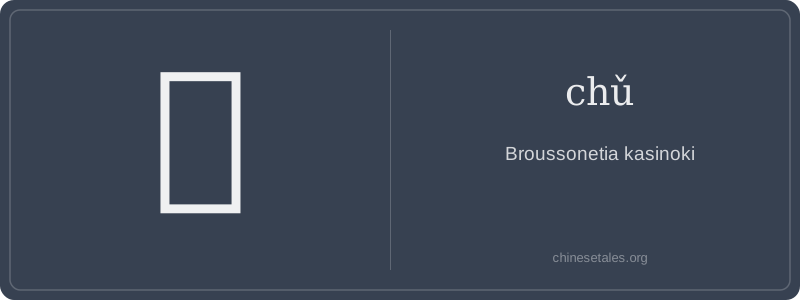
The earliest form of 楮 appears in seal script (zhuànshū), where the left side clearly shows the 木 radical — stylized branches and roots — and the right side resembles an early version of 主: a dot above a horizontal stroke, symbolizing authority or centrality over the tree. Over time, the dot became the top stroke of 主, and the horizontal stabilized into the three horizontal strokes we see today. By the late Han clerical script, the structure solidified: 木 + 主 — visually declaring 'this is the master tree among woods.' Not a pictograph of leaves or fruit, but a conceptual emblem of functional supremacy.
Its meaning never wavered: from the Warring States period onward, 楮 named Broussonetia specifically — mentioned in the *Classic of Mountains and Seas* (Shānhǎi Jīng) as a fiber source, and later celebrated in Li Shizhen’s *Compendium of Materia Medica* for both paper and medicinal bark. The character’s visual weight — 12 strokes, balanced yet grounded — mirrors the tree’s physical resilience and cultural endurance. Even today, when Japanese papermakers chant 'kōzo' (their reading of 楮), they’re echoing a pronunciation first carved into bamboo slips during the Han dynasty.
楮 (chǔ) is a quiet botanical specialist — not a daily conversational word, but a living fossil of Chinese ecological literacy. At its heart lies the paper mulberry tree (Broussonetia kazinoki), a fast-growing, fibrous deciduous tree native to East Asia. Its name evokes texture: rough bark, tough inner bast fibers, and the soft, resilient paper historically made from them. The character itself feels rooted and sturdy — literally, since its radical 木 (mù, 'tree') anchors it in the botanical world, while the right side 主 (zhǔ, 'master' or 'host') hints at prominence: this wasn’t just any tree — it was *the* tree of early papermaking.
Grammatically, 楮 functions almost exclusively as a noun, typically in compound words or classical contexts — you won’t say 'I saw a 楮' in casual speech. It appears in terms like 楮皮纸 (chǔ pí zhǐ, 'paper mulberry bark paper') or poetic references to ancient texts ('written on 楮'). Learners often misread it as zhǔ (confusing it with 主) or overgeneralize it as 'mulberry' broadly — but 楮 is *not* the silkworm mulberry (桑 sāng); it’s a distinct species prized for fiber, not fruit. Using it incorrectly risks sounding archaic or botanically imprecise.
Culturally, 楮 carries silent reverence: Tang and Song dynasty scholars wrote on 楮纸, and Buddhist sutras were copied onto it for durability. Today, artisans in Guizhou and Japan still handcraft washi using 楮 fibers — a continuity spanning 1,500 years. Mistaking it for a generic 'tree' misses its legacy as the unsung backbone of China’s literary transmission.