楗
Character Story & Explanation
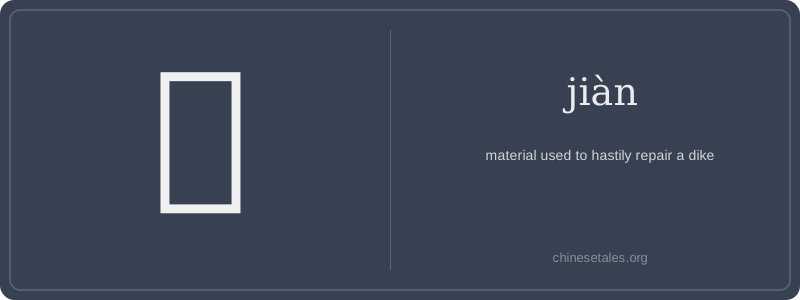
The earliest form of 楗 appears in Han dynasty bamboo slips, not oracle bones — fitting, since it emerged from practical water governance. Its structure is transparent: left side 木 (mù, 'tree/wood'), right side 戔 (jiān), which originally depicted two small blades cutting — suggesting *something thin, sharp, and penetrative*. Over time, the right-hand component stabilized into its current shape: two 'knife' radicals (刂) stacked, implying repeated, forceful insertion — exactly how laborers drove stakes into muddy embankments.
This visual logic became semantic reality. In the Book of Song (《宋书》), 楗 appears in records of Yellow River flood responses: '打楗塞决' (dǎ jiàn sāi jué) — 'drive stakes to seal the breach.' By the Qing dynasty, hydraulic manuals specified types: 麻筋楗 (má jīn jiàn, hemp-reinforced stakes) and 石楗 (shí jiàn, stone-weighted wooden ones). The character never drifted into metaphorical use — unlike many Chinese characters, 楗 stayed stubbornly literal, tethered to mud, water, and human urgency.
At first glance, 楗 (jiàn) feels like a linguistic fossil — it’s not in the HSK, rarely appears in modern textbooks, and even many native speakers haven’t typed it since middle school. But its meaning is vividly practical: it refers to *temporary wooden stakes or planks* hastily driven into breaches in river dikes during floods. It’s not elegant carpentry — it’s emergency improvisation, a stopgap that buys time before proper repair. That sense of urgency, pragmatism, and collective crisis response is deeply embedded in the character’s cultural DNA.
Grammatically, 楗 functions almost exclusively as a noun — often appearing in technical, historical, or agricultural contexts, usually paired with verbs like 打 (dǎ, 'to drive in'), 插 (chā, 'to insert'), or 塞 (sāi, 'to wedge'). You won’t hear it in casual speech ('I’ll grab some 楗 for the leaky sink!'), but you *will* see it in flood-control reports or Ming-dynasty hydraulic texts. Learners sometimes misread it as 鉴 (jiàn, 'mirror/standard') due to identical pronunciation — a mix-up that swaps engineering for philosophy!
Culturally, 楗 embodies China’s millennia-long relationship with water management: rivers nourish, but also threaten. The character doesn’t celebrate permanence — it honors *timely intervention*. Modern learners miss this nuance when they treat it as just another 'wood' radical word; it’s not about timber, but about *resilience under pressure*. Also beware: it’s easily miswritten as 建 (jiàn, 'to build') — a tiny stroke difference that turns 'emergency dike plug' into 'construction project'.