楎
Character Story & Explanation
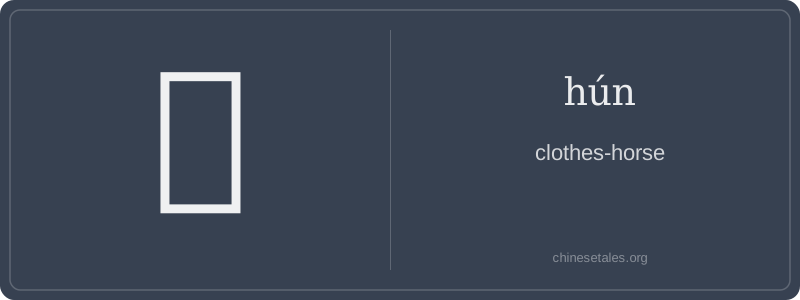
The earliest trace of 楎 appears not in oracle bones — too mundane for divination — but in Han dynasty bamboo slips and Tang stele inscriptions, where it emerges as a compound character: 木 (wood) on the left, 昏 (hūn, 'dusk') on the right. Wait — 'dusk'? Yes! But here, 昏 isn’t about time; it’s a phonetic loan (a *shēngpáng*) borrowed for its sound, not meaning. Visually, the right side evolved from the ancient form of 昏 — a person with a sun (日) descending below a horizon line — gradually simplifying into today’s 昏, then further stylized into the top-heavy, dot-studded shape we see in 楎. The left 木 radical anchors it firmly in the realm of wooden objects.
By the Song dynasty, 楎 had solidified as the standard term for a freestanding drying frame in domestic manuals and local gazetteers — notably in the *Wu Region Gazetteer*, which describes ‘bamboo 楎 erected in eastern courtyards during plum-rain season’. Its stability comes from the visual logic: wood + a phonetic that sounds like ‘hún’, echoing the low hum of wind through drying garments. No classical poetry romanticizes it — but its quiet presence in Ming furniture catalogs and Qing textile workshops proves it was essential infrastructure, not ornament: the unsung scaffold of daily life.
Think of 楎 (hún) as China’s answer to the Victorian clothes-horse — not the horse, but the freestanding wooden frame that holds damp laundry like a silent, stoic butler. It’s not a poetic or abstract term; it’s utilitarian, tactile, and deeply domestic — evoking sun-dappled courtyards, bamboo poles, and the quiet choreography of drying clothes in pre-modern Chinese households. Unlike English 'clothesline' (which implies string), 楎 specifically denotes the rigid, often X- or A-frame structure — so if you say 用楎晾衣服 (yòng hún liàng yīfú), you’re not just hanging clothes, you’re deploying hardware.
Grammatically, 楎 is a noun that rarely appears alone in modern speech — it’s mostly found in classical texts, regional dialects, or compound words like 楎架 (hún jià, 'clothes-horse frame'). You won’t hear it in HSK-level conversations (hence its absence from the list), and using it spontaneously in Beijing might earn you a polite, puzzled smile — like saying 'clothes-horse' instead of 'drying rack' at a Brooklyn laundromat. It resists verb derivation: you don’t *hún* something — you *liàng* (hang) *on* a hún.
Culturally, learners often misread 楎 as a rare variant of 混 (hùn, 'to mix') due to identical pronunciation in some dialects — but they share zero semantic ground. Others mistake it for 熏 (xūn, 'to smoke-cure'), misled by the ‘fire’-like component 灬. The real trap? Assuming it’s obsolete. It isn’t — it’s quietly alive in Jiangsu folk architecture records, Qing dynasty household inventories, and even contemporary textile museums describing historical laundry practices.