椄
Character Story & Explanation
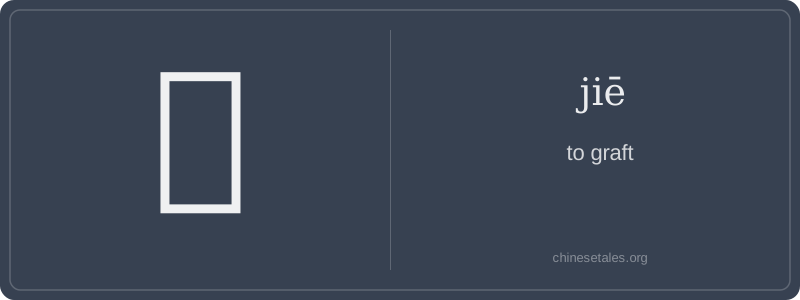
The earliest form of 椄 appears in late Warring States bamboo texts (not oracle bones — it’s too new for that era), built from the 木 (mù, 'tree') radical on the left and 接 (jiē, 'to join') on the right. Visually, it’s a deliberate fusion: the left side anchors it in the botanical world (wood, plants, growth), while the right side — itself composed of 扌 (hand radical) + 立 (standing) + 刂 (knife) — evokes the careful, manual act of cutting and binding. Over centuries, the right-hand component simplified from complex seal-script forms into today’s clean 接, but the core idea — 'hand-guided joining of wood' — never wavered.
By the Han dynasty, 椄 was already standard in agricultural manuals like the Fang Sheng Zhi Shu, describing how to graft mulberry trees for silk production. Its meaning never broadened into abstract 'joining' — unlike 接 or 合 — because Chinese botany historically demanded precision: successful grafting required matching cambium layers, timing with lunar cycles, and ritual care. The character’s unchanging focus on *living plant tissue* mirrors China’s ancient empirical science — not theoretical, but deeply observational, seasonal, and life-centered.
At its heart, 椄 (jiē) is a quiet specialist — not a flashy verb like 'to plant' or 'to grow,' but the precise, almost surgical act of grafting: joining two living plant parts so they grow as one. In Chinese, this isn’t just horticulture; it’s a metaphor for integration, continuity, and intentional fusion — think of inheriting family skills, merging traditions, or even adopting a child. The character feels technical yet deeply rooted in harmony: it implies respect for both donor and recipient, not domination.
Grammatically, 椄 is almost always transitive and requires an object (e.g., 椄枝, 椄接). You’ll rarely see it alone — it’s the engine inside compound verbs like 嫁接 (jiàjiē) or 椄穗 (jiēsuì), where it contributes the core idea of 'joining living tissue.' Learners often mistakenly use it like 接 (jiē, 'to connect') — but 椄 isn’t about plugging in cables or answering phones; it’s exclusively biological fusion with intentionality and care. You wouldn’t say 'I 椄 the call' — that’s a hard grammar trap.
Culturally, grafting reflects a profound Chinese value: growth through thoughtful combination, not replacement. Ancient farmers grafted peach scions onto wild rootstock to preserve fruit quality while gaining disease resistance — a literal embodiment of 'preserving essence while adapting form.' Modern learners miss this nuance when treating 椄 as mere synonym for 'attach'; it carries silent reverence for life’s continuity and human stewardship of nature’s design.