棻
Character Story & Explanation
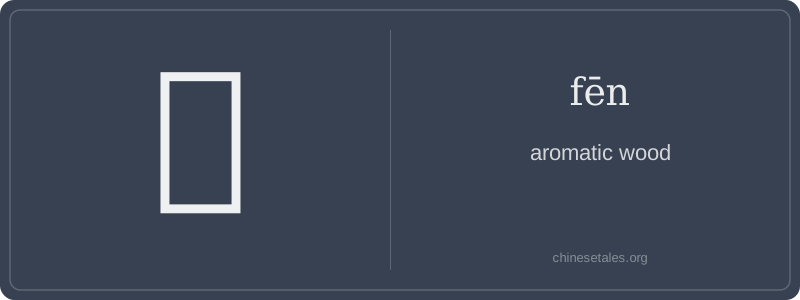
The earliest form of 棻 appears in Warring States bamboo slips, not oracle bones — and it’s a masterclass in visual economy. The left side 木 (mù) anchors it as a tree-related character, while the right side 分 (fēn) wasn’t originally 'to divide' but a stylized depiction of *splitting aromatic resin* from bark — think of tapping frankincense. Over centuries, the resin-dripping strokes simplified into the modern 分 shape, but the olfactory intent remained embedded: two hands (the 'eight' radical inside 分) carefully separating something precious and scented from the trunk.
By the Han dynasty, 棻 was codified in texts like the *Erya* (China’s oldest dictionary) as 'a fragrant tree whose wood repels insects and calms the mind'. It appeared in Tang poetry describing scholar-officials’ study desks — not for function, but for its quiet, grounding scent during meditation. The character’s structure mirrors its philosophy: 木 (nature) + 分 (discernment) = the wisdom to distinguish truly fine, harmonious materials from the ordinary. Even today, master carpenters in Suzhou still refer to premium nanmu as 棻木 — not because it’s botanically identical, but because it carries the same cultural resonance: wood that breathes with intention.
Imagine walking through an ancient Zhou dynasty forest — not just any woods, but a grove of rare, fragrant trees whose scent clung to silk robes and temple incense. That’s the soul of 棻 (fēn): not merely 'wood', but *aromatic wood* — specifically the kind used in ritual objects, high-grade lacquerware, and classical furniture. Its core feeling is quiet luxury: subtle, refined, and deeply tied to sensory reverence. You won’t find it in daily chatter — it’s a literary and artisanal word, like 'sandalwood' or 'rosewood' in English: precise, evocative, and slightly archaic.
Grammatically, 棻 functions almost exclusively as a noun modifier or standalone noun — never a verb or adjective. It rarely appears alone; instead, it glides into compounds like 棻木 (fēn mù) or 棻香 (fēn xiāng). Learners sometimes mistakenly try to use it like 木 (mù, 'wood') — say, in 'wooden table' — but that’s wrong: 棻 isn’t generic lumber. It’s the *kind* of wood that makes connoisseurs pause and inhale. Think of it as the 'vintage bourbon' of Chinese timber: specific origin, distinct aroma, and zero tolerance for substitution.
Culturally, 棻 carries echoes of Confucian material ethics — where even wood had moral weight if it embodied harmony and purity. Mistake it for 坟 (fén, 'grave')? Easy — same tone, similar right-side component — but the gulf between 'fragrant timber' and 'burial mound' is both semantic and emotional whiplash. This character doesn’t shout; it whispers — and demands you listen closely.