棬
Character Story & Explanation
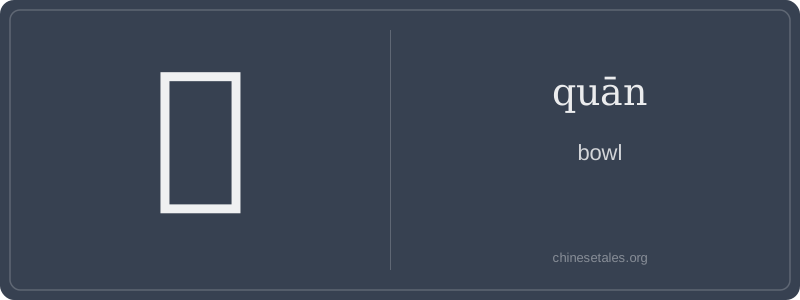
The earliest form of 棬 appears on late Shang oracle bones and Western Zhou bronzes as a stylized pictograph: a rounded, open-topped container resting on a short base, sometimes with a horizontal line indicating the rim — very much like a shallow basin viewed from the side. Over centuries, the top evolved into the 'quan' (quān) phonetic component (巛 + 口), while the bottom solidified into the 木 (mù, 'tree/wood') radical — reflecting how early ritual bowls were crafted from lacquered wood or bamboo frames. By the Han clerical script, the shape had stabilized into the modern structure: top-heavy phonetic above a sturdy wooden base.
This character appears in the *Shuōwén Jiězì* (c. 100 CE) as 'a vessel for holding grain, made of wood or lacquer, used in rites'. It surfaces in the *Rites of Zhou* (*Zhōulǐ*) describing ceremonial food presentation, and once in the *Zuo Zhuan* (5th c. BCE) describing sacrificial vessels 'stacked like mountains — three 棬 atop two dòu'. Its visual form — round mouth, stable base, wooden root — wasn’t just decorative; it encoded function (containment), material (lacquered timber), and ritual gravity (upright, centered, grounded).
Let’s start with a confession: 棬 (quān) is a ghost character — technically real, historically attested, but functionally extinct in modern Standard Mandarin. It *means* 'bowl', yes, but you’ll never hear it spoken aloud in daily life or see it in textbooks, menus, or even dictionaries aimed at learners. Its core semantic feel is archaic and tactile: imagine a shallow, rounded, earthenware vessel used for rice or soup in pre-Qin ritual contexts — not the sleek porcelain bowl (碗 wǎn) you hold today, but something earthier, heavier, more ceremonial.
Grammatically, 棬 functions exclusively as a noun and appears only in classical compounds or rare literary allusions. You won’t use it predicatively ('This is a 棬') or with measure words like 个 (gè) — it resists modern syntax entirely. Attempting to say 'I bought a 棬' (wǒ mǎi le yī gè quān) sounds like quoting a bronze inscription at a tea ceremony. Instead, if you need 'bowl' in speech or writing, reach for 碗 (wǎn), 盅 (zhōng), or 杯 (bēi) — each with precise register and material connotations.
Culturally, 棬 whispers of Zhou dynasty bronze inscriptions and early ritual vessels — think of the *guǐ* (簋) food containers used in ancestral sacrifices. Learners’ biggest trap? Assuming it’s a variant or synonym of 碗. It’s not — it’s a fossilized lexical cousin. Also, beware mistaking its radical (木) for 'wood'; here it signals *material origin* (early bowls were often lacquered wood or bamboo-reinforced clay), not literal woodiness. Its silence in modern usage is its most telling feature.