棤
Character Story & Explanation
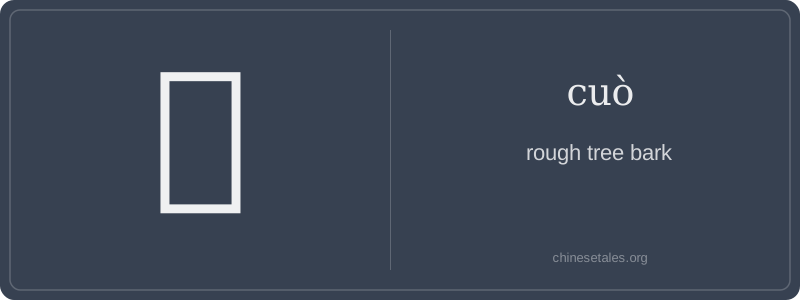
The earliest form of 棤 appears in late Warring States bamboo slips — not oracle bone, but close: a left-side ‘wood’ radical (木) fused with a right-side component resembling three jagged, intersecting strokes (昔), originally depicting cracked, layered bark under magnification — like cross-sections of cork cells drawn by a meticulous botanist-artist. Over centuries, the right side simplified from 口+日+一 to 昔 (xī), phonetically borrowed for its sound, while the wood radical anchored meaning. By the Han dynasty clerical script, the character stabilized into its current structure: 木 + 昔 — visually echoing how bark *covers* (昔 sounds like ‘xi’, hinting at ‘covering over time’) the enduring wooden core.
This semantic evolution reflects Chinese ecological observation: bark isn’t just skin — it’s armor, record, and relic. In the *Classic of Mountains and Seas* (Shānhǎi Jīng), 棤 appears describing the ‘thorn-barked cypress’ guarding immortal peaks — where texture signaled sacred boundary. Later, in Ming dynasty herbal manuals, it distinguished medicinal barks (like phellodendron) by surface coarseness. The character’s visual weight — dense, angular, slightly uneven — mirrors its meaning: no smoothness here, only time-worn resistance.
Imagine running your fingers over the gnarled, flaky bark of an ancient camphor tree — that’s the visceral, tactile essence of 棤 (cuò). It doesn’t mean ‘tree’ or ‘bark’ in a generic way; it specifically evokes the coarse, fissured, almost scaly texture of mature hardwood bark — think the kind that peels in ragged curls and catches on your sleeve. This isn’t a word you’d use in daily chat; it’s a literary and botanical whisper, found in classical texts, forestry reports, or poetic descriptions of rugged mountain landscapes.
Grammatically, 棤 is almost always a noun — rarely a verb or adjective — and appears in compound nouns or descriptive phrases. You won’t say ‘the tree is 棤’, but rather ‘the trunk’s 棤 is deeply furrowed’ (树干的棤深裂如鳞). It never stands alone as a subject or predicate; it needs context: a modifier (like 老松的 — ‘old pine’s’) or a classifier (e.g., 一层 — ‘a layer of’). Learners often mistakenly treat it like a verb (‘to roughen’) or confuse it with similar-sounding words like 错 (error), leading to comically off-target sentences like ‘I cuò the bark’ — which sounds like ‘I error the bark’ in Mandarin!
Culturally, 棤 carries quiet reverence for nature’s unpolished resilience. In classical poetry, it signals endurance — the bark outlives leaves, branches, even storms. Modern usage is rare outside ecological writing or heritage conservation documents, so encountering it feels like finding a fossilized leaf pressed into a dictionary page. Its obscurity makes it a delightful ‘deep cut’ for advanced learners — not for fluency, but for texture, authenticity, and the joy of naming the world precisely.