棘
Character Story & Explanation
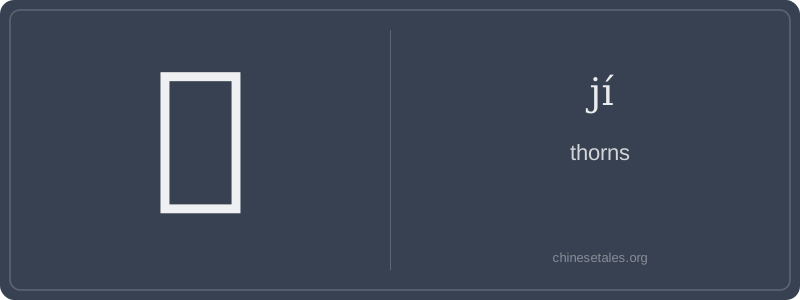
The earliest form of 棘 appears in bronze inscriptions as a symmetrical, almost geometric pictograph: two upward-pointing ‘wood’ elements flanking a central vertical stroke — mimicking the paired, needle-sharp thorns that sprout directly from the trunk of the jujube thorn tree. Over centuries, the central stem solidified into the radical 木 on the left, while the right side evolved from twin thorn clusters into the stylized 朿 (cì), itself a character meaning ‘thorn’ (and later, ‘to pierce’). By the Han dynasty, the modern 12-stroke form was standardized — with the left 木 anchoring the meaning (tree), and the right 朿 doubling down on sharpness, literally and graphically.
This visual doubling wasn’t accidental: ancient Chinese farmers knew this tree’s thorns grew in opposing pairs — a botanical fact baked into the script. In the *Classic of Poetry* (Shī Jīng), 棘 appears in odes describing frontier walls lined with thorn hedges to deter invaders — turning botany into boundary. Later, Mencius contrasted 棘 (harsh, obstructive) with 桑 (sāng, mulberry — soft, nurturing) to symbolize moral choice. Even today, the character’s rigid symmetry feels like a warning: approach with care, or get pricked.
Think of 棘 (jí) as Chinese for 'thorn' — but not the gentle rose-prickle kind. It’s the medieval English hedgehog’s cousin: spiky, defensive, and unapologetically sharp. In Classical Chinese, 棘 referred specifically to the *jujube thorn tree* (Ziziphus jujuba var. spinosa), a gnarled, densely thorned shrub used historically for living fences — imagine barbed wire made of wood and time. Unlike English ‘thorn’, which can be poetic or abstract (‘a thorn in my side’), 棘 almost always appears in compound words or literary contexts; you’ll rarely see it solo in modern speech — it’s more ‘Shakespearean prick’ than ‘Instagram caption’.
Grammatically, 棘 is a noun and never a verb — no ‘to棘’ nonsense. It only shows up in set phrases like 棘手 (jí shǒu, ‘thorny-handed’ = difficult to handle) or 棘荆 (jí jīng, an archaic variant meaning ‘thorny brambles’). Learners sometimes misread it as ‘jì’ (like 既) or confuse its double-木 structure with 林 (lín, ‘forest’) — but here’s the kicker: those two 木 radicals aren’t just decorative — they’re *twin thorn clusters*, visually echoing how real jujube thorns grow in pairs along the stem.
Culturally, 棘 carries connotations of obstruction, danger, and moral difficulty — Confucius used 棘荆 in the *Analects* (17.22) to describe a path blocked by ethical thorns, not bushes. Modern learners often overuse it trying to sound ‘literary’, but native speakers reserve it for formal writing, idioms, or historical descriptions. A common mistake? Using 棘 alone as a standalone noun like ‘thorn’ — it’s grammatically off. Think of it as a ‘compound-only character’, like English ‘whence’ or ‘hither’: elegant, rare, and best left in context.