棑
Character Story & Explanation
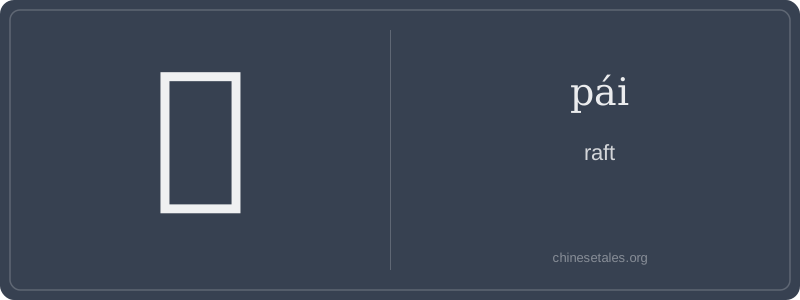
The earliest form of 棑 appears in Han dynasty clerical script (lìshū), not oracle bones — because rafts were too ephemeral to leave archaeological traces, yet vital enough to earn a dedicated character. Its left radical, 木 (mù, ‘tree’), anchors it firmly in the material world: wood. The right side, 排 (pái), originally depicted two hands pushing apart — later generalized to ‘arrange in rows’ or ‘push forward’. Together, they visually narrate the act: *wood arranged and pushed together* — logs bound into a floating platform. Over centuries, the top horizontal stroke of 排 stabilized, the two ‘hands’ (扌) fused into a cleaner vertical structure, and the whole character gained its balanced, slightly elongated proportions.
This visual logic mirrors its semantic evolution: from a concrete tool (a river raft) to a metaphor for collective action — hence 排 also means ‘to line up’ or ‘to expel’, implying coordinated force. In the Classic of Poetry (Shījīng), rafts appear implicitly in verses about crossing rivers during migrations; by the Tang dynasty, poets like Li Bai used 棑 evocatively: ‘a single 棑 beneath autumn clouds’ — where the raft symbolizes solitude and surrender to fate. Its shape still whispers that duality: raw material + human arrangement = fragile yet purposeful motion.
At its heart, 棑 (pái) isn’t just a neutral ‘raft’ — it’s a humble, handmade vessel of survival and mobility on rivers that shaped China’s agrarian civilization. Unlike the sleek, modern 筏 (fá), which is generic and often inflatable, 棑 carries a rustic, historical weight: think bamboo or wooden logs lashed together by hand, drifting down the Yangtze or Pearl River centuries ago. Native speakers instinctively associate it with resilience, impermanence, and quiet resourcefulness — not adventure, but necessity. You’ll rarely hear it in daily speech today; it lives mostly in literature, idioms, and regional dialects.
Grammatically, 棑 functions almost exclusively as a noun and appears in compound words rather than standalone. It doesn’t take aspect markers (了, 过) or measure words like 个 — instead, it pairs with specific classifiers like 架 (jià, for vehicles/structures) or more commonly, no classifier at all in poetic or literary contexts. Learners sometimes try to use it like 船 (chuán, ‘boat’) — but 棑 has no engine, no deck, no steering: it floats *with* the current, never against it. That semantic restraint is key.
Culturally, 棑 evokes the ancient trope of the ‘drifting scholar’ — a literati figure exiled downstream, contemplating life on a simple raft. Mistaking it for 筏 or 竹 (zhú, ‘bamboo’) is common, but the real trap is overusing it: it’s not archaic per se, but it’s stylistically marked — like saying ‘steed’ instead of ‘horse’ in English. Use it deliberately, and you signal literary awareness; misuse it, and you sound oddly ornate in casual talk.