梭
Character Story & Explanation
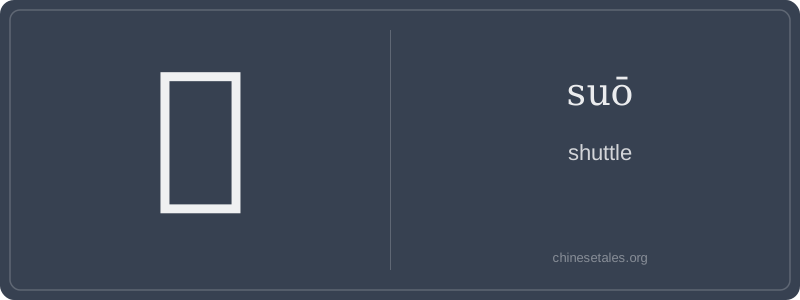
The earliest form of 梭 appears in seal script (c. 3rd century BCE), where it clearly shows a central 'wood' radical (木) flanked by two symmetrical, angular strokes — representing the tapered, pointed ends of a traditional shuttle. These outer strokes evolved from pictographic depictions of carved wooden tips; over centuries, the top and bottom 'points' simplified into the current and 丿 shapes, while the middle retained 木 — confirming its material origin: shuttles were always carved from fine hardwood like sandalwood or pearwood for smooth gliding.
This visual logic held firm across dynasties: in the Shuōwén Jiězì (121 CE), Xu Shen defined 梭 as 'a tool that moves rapidly through threads', linking form directly to function. By Tang poetry, 梭 had already leapt beyond weaving — Li Bai wrote of stars 'shuttling' across the night sky, and Song scholars used 梭巡 to describe imperial guards moving with silent, swift vigilance. Its wood radical isn’t decorative: it anchors the character in tangible craft, reminding us that even abstract motion — like time or attention — was first understood through the body’s work with wood and thread.
Imagine a 19th-century silk workshop in Suzhou: the rhythmic *click-clack-click* of a wooden loom fills the air as a slender, pointed shuttle — shaped like a tiny boat with tapered ends — zips back and forth through warp threads, carrying weft silk. That’s 梭 (suō): not just a tool, but a verb for *darting*, *shooting*, or *flitting* — it carries motion, speed, and precision. In modern Chinese, 梭 almost never stands alone as a noun meaning 'shuttle' (that usage is rare outside technical textile contexts); instead, it lives vividly in verbs like 梭来梭去 (suō lái suō qù, 'to dart back and forth') or as part of compound verbs like 梭巡 (suō xún, 'to patrol swiftly').
Grammatically, 梭 is nearly always reduplicated or paired — you’ll rarely see it solo. Learners often mistakenly treat it like a standalone noun ('the shuttle'), leading to unnatural phrasing. Instead, think of it as an *action-sound*: its sharp 'suō' sound mimics the hiss of something slicing through air or fabric. It appears in literary metaphors too — time 梭过 (suō guò, 'darts past'), eyes 梭视 (suō shì, 'scan sharply') — always implying rapid, linear, purposeful movement.
Culturally, 梭 evokes craftsmanship and quiet mastery: the shuttle doesn’t shout — it works tirelessly, unseen, binding threads into cloth. A common learner trap? Confusing it with similar-sounding words like 缩 (suō, 'to shrink') — but while 缩 pulls inward, 梭 shoots outward. Also, don’t miss its poetic weight: in classical poetry, 梭 symbolizes fleeting moments — life as thread, time as shuttle.