桭
Character Story & Explanation
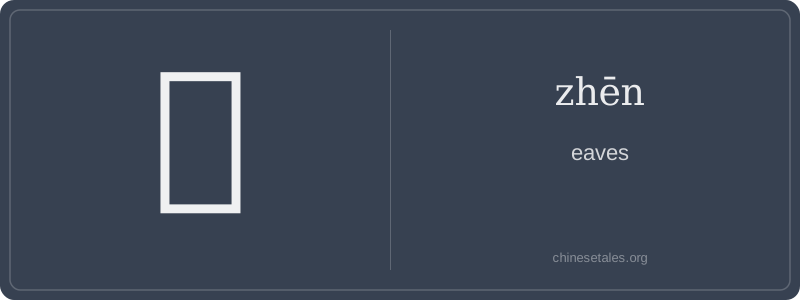
The earliest form of 桭 appears on bronze inscriptions from the late Zhou dynasty (c. 5th century BCE) as a pictograph showing a roof with two downward-curving lines beneath it — unmistakably the projecting edge of a tiled eave. The top part (厂) represented the slanted roofline, while the lower component (木) was added later to clarify its material origin: wood — the structural beam supporting the overhang. Over centuries, the roof element evolved into the modern 厂 radical, and the wooden support solidified into the 木 radical at the bottom, yielding the balanced, upright form we see today: a visual echo of how eaves literally 'lean out' from the building’s frame.
This character appears in the *Classic of Poetry* (Shījīng), where 'the eaves drip in autumn rain' (檐滴秋声) evokes melancholy stillness — cementing 桭 as a vessel for atmosphere, not architecture. By the Tang dynasty, poets like Du Fu used 桭 to mark thresholds of safety and intimacy: 'beneath the same eave' (同檐下) implied shared refuge during turmoil. Its shape — stable yet outward-leaning — mirrors this dual role: protection that reaches outward, structure that invites contemplation. Even today, master calligraphers pause before writing 桭, tracing its two radicals as if balancing weight and grace.
Think of 桭 (zhēn) as the architectural 'eyebrow' of a traditional Chinese building — not the roof itself, but the graceful overhang that shades the walls like a brow shielding the eyes. In English, 'eaves' feels technical and rarely used outside construction manuals; in Chinese, 桭 carries poetic weight: it evokes quiet courtyards, rain dripping rhythmically onto stone, and the subtle boundary between shelter and sky. You’ll almost never see it in spoken Mandarin today — it’s a literary relic, like 'whence' or 'hither' in English — appearing mainly in classical poetry, historical descriptions, or architectural writing.
Grammatically, 桭 is a noun and almost always appears in compounds (like 檐角 or 飞檐), rarely alone. Learners sometimes try to use it like a verb ('to eave') or confuse it with verbs meaning 'to extend' — but no: it’s strictly a concrete, static noun. It also never takes aspect particles (了, 过) or measure words like 个; instead, it pairs with 一 for emphasis: 一檐之隔 ('a single eave’s distance' — meaning 'just a hair’s breadth away').
Culturally, 桭 isn’t just wood and tile — it’s loaded with symbolism. In Song dynasty painting theory, the curve of the eave (especially the upturned corners of 飞檐) expressed harmony between human artifice and natural flow. Modern learners often misread it as 簷 (yán), its simplified variant — but 桭 is the original, pre-Qin form, preserved in calligraphy and scholarly texts. Using 桭 instead of 簷 signals deliberate classical register — like quoting Shakespeare mid-conversation.