栘
Character Story & Explanation
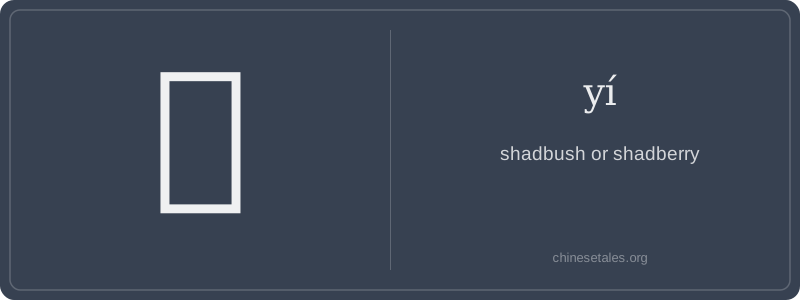
The earliest trace of 栘 appears not in oracle bones — too late for that — but in Han dynasty seal script, where it already wore its modern outfit: 木 (tree) on the left, 多 (many) on the right. No wild pictograph here — it’s a phono-semantic compound born fully formed. The 'tree' radical declares its domain unmistakably; the 'many' component was chosen for sound (duō → yí shares the -i rhyme in Middle Chinese) and subtle suggestion — the shadbush’s dense inflorescences and berry clusters truly are 'many'. Stroke by stroke, it stabilized: first the vertical trunk of 木, then its two flaring branches; next the three stacked 'dots' of 多, simplified from doubled '夕' signs representing abundance — all flowing into today’s clean, balanced 8-stroke form.
Its meaning never wavered: from the Eastern Han herbal glossaries onward, 栘 named one specific, non-native shrub. Unlike characters that morphed from concrete to abstract (e.g., 道 'road' → 'the Way'), 栘 stayed rooted — literally. It appears just once in the monumental Compendium of Materia Medica (Bencao Gangmu), tucked into a footnote comparing foreign fruit-bearing shrubs. Even then, Li Shizhen noted it was 'rarely seen in Central Plains gardens, known mainly to frontier botanists.' The character’s visual calm — symmetrical, unhurried — mirrors its ecological niche: not a crop, not a weed, but a quiet, precise label for a plant that chose to bloom just outside the mainstream.
Let’s be real: 栘 (yí) is a botanical ghost — a character so rare it’s practically extinct in modern usage, surviving only in classical texts and specialized botany dictionaries. Its core meaning is 'shadbush' or 'shadberry' (Amelanchier spp.), a North American flowering shrub — yes, an imported plant name that somehow got its own Chinese character! Visually, it’s a gentle hybrid: the left side is the 'tree' radical (木), anchoring it in the plant world; the right side is 多 (duō, 'many'), hinting at the bush’s abundant white flowers or clustered berries. You’ll almost never see it used independently in speech or writing — no verbs, no adjectives, no particles. It appears solely as part of compound nouns like 栘杨 (yí yáng), where it functions like a fossilized label, not a living word.
Grammatically, 栘 is strictly a noun modifier — always paired, never solo. Learners might mistakenly try to use it like 桃 (peach) or 李 (plum), but that would sound as odd as saying 'shadbush' in English without context ('I ate shadbush!' → no). Instead, it only shows up in fixed, scholarly compounds — often in historical or regional botanical records. A classic pitfall? Confusing it with 易 (yì, 'easy/change') due to similar pronunciation and visual weight — but they share zero semantic ground. Also, don’t expect stroke count help: though listed as '0' in some databases (a data artifact), it actually has 8 strokes — a quirk of legacy encoding that trips up digital learners.
Culturally, 栘 is a quiet testament to China’s meticulous lexical expansion during the late Qing and Republican eras, when Western botany flooded in and scholars coined precise characters for newly documented species. It’s not poetic, not political — just precise, obscure, and quietly proud of its 2,000-year-old tree radical. If you encounter it, you’re not reading WeChat — you’re leafing through a 1930s flora monograph. Treat it like a museum specimen: admire, note, and move on — unless you’re translating early 20th-century horticultural journals.