栅
Character Story & Explanation
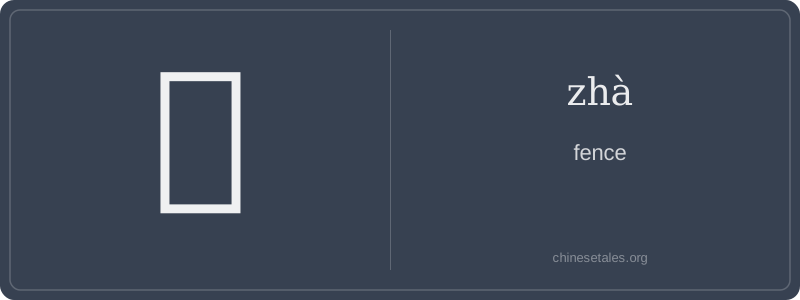
The earliest form of 栅 appears in bronze inscriptions as two vertical lines (representing upright posts) flanked by parallel horizontal strokes (crossbars), all enclosed within a simplified ‘tree’ or ‘wood’ frame — essentially a pictograph of a wooden palisade. Over time, the enclosing frame evolved into the 木 (wood) radical on the left, while the right side condensed from a complex arrangement of stakes and beams into the modern 从 (cóng) component — not ‘follow’, but a phonetic loan that hints at pronunciation (zhà shares sound-family links with 乍 and 作). The nine strokes today neatly encode this structure: four for the wood radical (一丨丿丶), five for the right side (ノノノ丨一).
This character’s meaning stayed remarkably stable across three millennia: always a barrier built from cut timber — not woven reeds (that’s 篱) or stone (that’s 墙). In the Zuo Zhuan, armies ‘立栅为营’ (lì zhà wéi yíng) — ‘erected wooden barriers to form camps’. Its visual logic is brilliantly literal: 木 says ‘made of wood’, and the stacked parallel strokes on the right mimic the repeated bars of a grille. Even today, when you see 栅 in a word like 铁栅门 (tiě zhà mén), your eye still reads ‘wood-like structure’ — a testament to how deeply materiality is baked into Chinese character semantics.
Think of 栅 (zhà) as China’s answer to the picket fence — not the decorative kind in front yards, but the sturdy, functional barrier you’d find around a military encampment or a livestock pen. Its core meaning is ‘fence’ or ‘barrier’, but unlike English ‘fence’, it’s almost never used alone in speech; it appears almost exclusively in compound words (like 铁栅 or 竹栅) and carries a faintly archaic, structural, or even defensive connotation — like ‘barricade’ or ‘stockade’ rather than ‘garden fence’.
Grammatically, 栅 is a noun-only character: you’ll never see it as a verb (no ‘to fence’), nor does it take aspect particles like 了 or 过. It pairs tightly with material classifiers — 木栅 (wooden fence), 铁栅 (iron grille), 竹栅 (bamboo palisade) — and often appears in formal or descriptive writing, not casual conversation. Learners sometimes mistakenly use it where 围栏 (wéilán, ‘enclosure’) or 篱笆 (líba, ‘hedge/fence’) would be more natural — e.g., saying *‘我家有栅’ instead of ‘我家有篱笆’ — which sounds oddly militarized or literary.
Culturally, 栅 evokes historical fortifications: ancient city walls had outer 栅栏 (zhàlán) made of sharpened stakes, and classical texts like the Book of Rites mention ‘木栅’ for boundary demarcation and defense. Modern usage leans technical or poetic — you’ll spot it in architecture descriptions, security system manuals, or lyrical prose — but rarely in daily chat. Bonus quirk: its pronunciation zhà rhymes with ‘cha!’ — as if shouting ‘CHA! Barrier up!’ — a fun auditory anchor.