柘
Character Story & Explanation
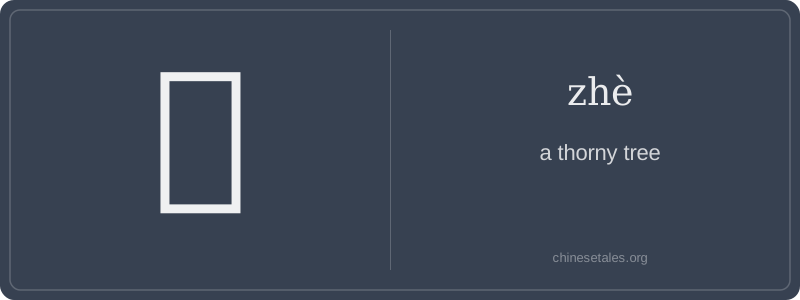
The earliest form of 柘 appears in bronze inscriptions as a combination of 木 (tree) and 石 (stone), later simplified to 木 + 豕 — but wait! That’s not 'pig' (shǐ) — it’s a stylized depiction of thorny branches branching sharply upward, mimicking the jagged silhouette of the real 柘 tree. Over centuries, the top element evolved from a complex thorn cluster into the streamlined 豕 shape we see today — not because pigs live in trees, but because scribes prioritized speed over pictorial fidelity. The left-side 木 radical stayed constant, anchoring it firmly in the botanical realm. By the Han dynasty, the 9-stroke form stabilized: four strokes for 木, five for the right side — a perfect visual echo of the tree’s compact, spiky growth habit.
This character’s meaning never wavered: always the specific deciduous tree (Cudrania tricuspidata), prized since Shang times for its dye, medicine, and timber. In the *Shijing* (Classic of Poetry), 柘 appears in verses describing frontier lands where 'the zhe grows thick and thorny' — symbolizing resilience and untamed nature. Later, during the Tang, its golden-yellow dye became synonymous with elite status: imperial edicts specified '柘黄' (zhè huáng, 'zhe-yellow') for robes reserved only for the emperor. Even today, in southern China, elders still call it 'the tree that remembers the Silk Road' — because its leaves once fed the silkworms whose thread stitched empires together.
Think of 柘 (zhè) not as just 'a thorny tree' but as a quiet, ancient presence — the kind that grows stubbornly on rocky slopes, its bark dark and fissured, its leaves feeding silkworms that spin imperial-grade silk. It’s not a common word in daily speech, but when it appears, it carries botanical precision and cultural weight: this isn’t *any* tree — it’s the mulberry-family tree whose tough wood was carved into bows, whose yellow dye tinted Tang dynasty robes, and whose leaves sustained rare silkworm strains. You’ll rarely see it as a standalone noun in casual chat; instead, it anchors compound words like 柘木 (zhè mù, 'zhe wood') or appears in place names and classical poetry.
Grammatically, 柘 behaves like most noun-classifying plant characters: it can be modified by measure words (e.g., 一棵柘), used attributively before other nouns (柘叶, 'zhe leaves'), or serve as the subject/object in descriptive sentences. But here’s where learners stumble: because it’s absent from HSK and rarely taught, many misread it as 這 (zhè, 'this') — especially in cursive handwriting — leading to hilarious misinterpretations like 'this tree' instead of 'zhe tree'. Also, its pronunciation zhè rhymes with 'duh', not 'jeh' — so avoid the temptation to say 'je'!
Culturally, 柘 is a silent witness to China’s textile history. In the *Qimin Yaoshu* (6th c. agricultural manual), 柘 is praised for producing superior silk when fed to certain silkworms. Its wood was so dense and resilient it was called 'ironwood' in folk usage. Today, you’ll encounter it mostly in botany texts, heritage conservation reports, or poetic lines evoking rustic antiquity — never in 'How are you?' dialogues. Embrace it as a linguistic heirloom, not vocabulary for ordering dumplings.