柅
Character Story & Explanation
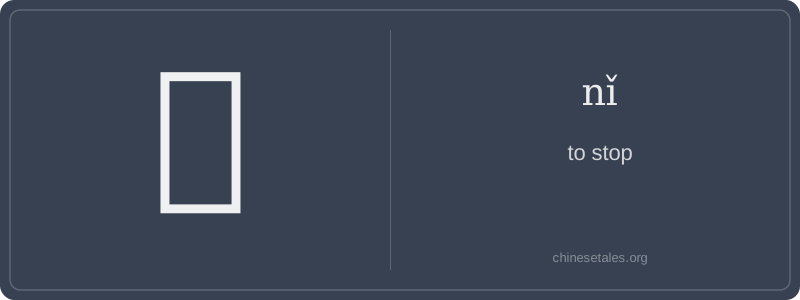
The earliest form of 柅 appears on Warring States bamboo slips as a pictograph combining 木 (wood) on the left and 尼 (nǐ, originally depicting a person crouching under a roof — implying 'to press down' or 'restrain') on the right. The bronze script version already shows the 'wooden peg' concept: imagine a vertical wooden post (木) inserted into a wheel hub, physically jamming rotation. Over centuries, 尼 simplified from a kneeling figure + roof to its current shape — losing its human posture but keeping its phonetic and semantic weight of suppression.
This character wasn’t born from philosophy — it was forged in axle grease. In the *Zhou Li* (Rites of Zhou), 柅 appears in descriptions of chariot maintenance: '柅轮以固轴' ('Insert the 柅 peg into the wheel to stabilize the axle'). By the Han dynasty, its meaning expanded metaphorically — Sima Qian used 柅 in the *Shiji* to describe halting reckless ambition. Even today, calligraphers note how the balanced left-right structure visually mimics a peg holding two rotating parts in check: the stillness is structural, not passive.
Let’s get real: 柅 (nǐ) is a quiet ghost of classical Chinese — it means 'to stop' or 'to halt', but you’ll almost never hear it in modern speech. It’s not about slamming brakes; it’s the elegant, deliberate pause of a chariot wheel held by a wooden peg — ancient, precise, and deeply physical. This isn’t an abstract verb like 停 (tíng); 柅 evokes resistance, friction, and mechanical restraint. Its core feel is *tactile stasis*: something solid arresting motion.
Grammatically, 柅 is nearly extinct as a standalone verb in contemporary usage — you won’t say '我柅住车' (I stopped the car). Instead, it survives almost exclusively in literary compounds (like 柅止, 柅轮) and classical allusions. When it does appear, it’s often in parallel constructions with other archaic verbs (e.g., 柅而不行 — 'halted and did not proceed') or as a causative verb meaning 'to cause to stop'. Learners mistakenly try to substitute it for common stop-verbs like 停, 止, or 制 — but doing so sounds like quoting a bronze inscription at a coffee shop.
Culturally, 柅 carries the weight of Zhou-dynasty engineering and cosmological order: stopping wasn’t just practical — it was moral discipline. Confucian texts use it metaphorically for curbing desire ('柅欲'), echoing the idea that virtue begins with restraint. A classic learner trap? Assuming its wood radical (木) implies 'wood-related' in a literal sense — nope! Here, 木 signals *material substance*, anchoring the action in tangible reality, not botany. Also, beware tone: nǐ (third tone) — not ní or nì!