枒
Character Story & Explanation
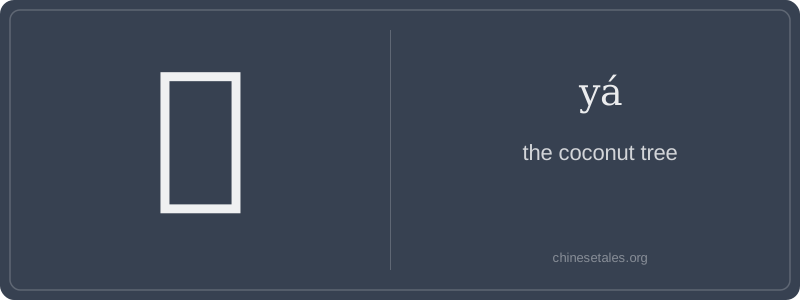
The earliest form of 枒 isn’t found in oracle bones (too late for palms in Shang inscriptions), but its structure reveals its story clearly: left side 木 (mù, 'tree') anchors it in the botanical realm, while the right side is 叉 (chā, 'fork' or 'prong'), stylized here as 丫 — a visual echo of the coconut palm’s iconic Y-shaped branching crown. In seal script (c. 3rd century BCE), the right-hand element was drawn with two diverging strokes rising from a base — unmistakably mimicking the split fronds unfurling high above the trunk. Over centuries, the top stroke simplified, the lower fork became more angular, and the whole character condensed into its modern 8-stroke elegance: 木 + 丫, clean and vertical like the tree itself.
This visual logic carried semantic weight: 枒 didn’t just mean 'palm' generically — it specifically denoted the *tall, slender, bifurcated* species native to southern China and Southeast Asia, distinguishing it from broader terms like 棕 (zōng, 'palm') or 椰 (yē, 'coconut'). Classical references are sparse — unsurprising for a regional tree — but 枒 appears in Ming-dynasty agricultural manuals describing Hainan’s coastal flora, always paired with descriptors like 高直 (gāo zhí, 'tall and straight') and 叶如羽 (yè rú yǔ, 'leaves like feathers'). Its shape *is* its meaning: two arms reaching skyward, rooted firmly in wood — nature’s perfect forked monument.
Think of 枒 (yá) as Chinese botany’s 'coconut tree whisperer' — a rare, poetic character that doesn’t just name the palm but evokes its slender, swaying silhouette against tropical light. Unlike common nouns like 树 (shù, 'tree') or 椰子 (yēzi, 'coconut'), 枒 carries literary weight: it’s not for grocery lists or weather reports, but for classical poetry, botanical texts, and regional dialect writing (especially in Hainan and Guangdong). You’ll almost never hear it in daily speech — even native speakers may pause and say 'Oh, *that* one!' — which makes it less a vocabulary item and more a cultural artifact you stumble upon like an old postcard.
Grammatically, 枒 behaves like a countable noun and usually appears with classifiers like 棵 (kē) or 株 (zhū), as in 一棵枒 (yī kē yá, 'one coconut tree'). It rarely stands alone — you won’t say 'I planted 枒'; you’ll say 'I planted a 枒 sapling' (一株枒苗). Crucially, it’s *not* interchangeable with 椰 (yē), the far more common character for 'coconut' — using 枒 instead of 椰 in 'coconut water' (椰子水) would sound archaic or deliberately ornate, like saying 'thou' instead of 'you' at a coffee shop.
Culturally, learners often misread 枒 as a variant of 牙 (yá, 'tooth') due to identical pronunciation and shared right-side component — a classic 'sound-alike trap'. But while 牙 is sharp, bony, and oral, 枒 is tall, leafy, and coastal. Another pitfall: assuming it’s used in compound words like 椰枒 (yē yá) — no such term exists! The character stands solo or in fixed botanical phrases. Its rarity means dictionaries sometimes list it as 'archaic' or 'dialectal', yet it remains alive in ecological conservation documents and Hainanese literature — a quiet testament to linguistic biodiversity.