杞
Character Story & Explanation
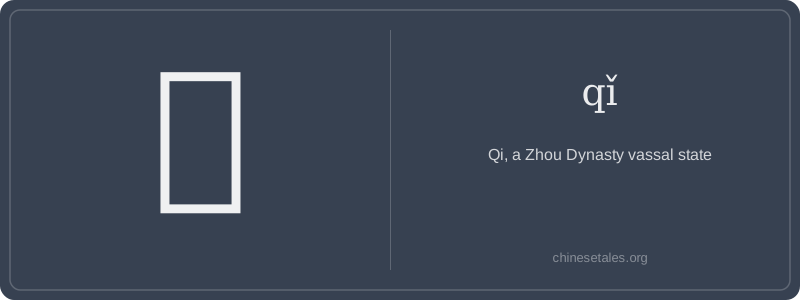
The earliest form of 杞 appears on Western Zhou bronze inscriptions as a composite: a tree (木) on the left — not as meaning ‘wood’, but as a phonetic anchor — and 古 (gǔ, ‘ancient’) on the right, stylized with a curved top and crossbar. Over centuries, 古 simplified: its top became (a bent line), the middle horizontal shortened, and the lower ‘ten’-shaped component (十) evolved into the clean, angular 旦-like shape we see today. By the Small Seal Script (c. 220 BCE), the left 木 had stabilized, and the right had crystallized into the modern 杞 — seven strokes total: 木 (4) + 3 more in the right-hand component.
This character wasn’t invented for abstraction — it was carved onto ancestral bronzes to name the land granted to Duke Donglou, a descendant of Yu the Great. Its meaning never drifted: 杞 always meant *that specific state* — first a political entity, then, after its conquest by Chu in 445 BCE, a poetic emblem of vanished glory. Confucius mentions ‘the rites of Qi’ in the *Analects* (3.25), referencing its preserved Zhou customs. The visual pairing of 木 (enduring, rooted) and 古 (time-worn, venerable) subtly reinforces its identity: a place whose legacy grows deeper, not taller — like roots, not branches.
Imagine you’re hiking through a misty mountain valley in Shandong Province, and your guide points to a weathered stone stele inscribed with the character 杞. ‘This was the capital of the ancient Qi (Qǐ) State,’ she says — not the famous Qi (Qí) of the Warring States, but the much older, smaller, and tragically overlooked vassal state enfeoffed by King Wu of Zhou around 1046 BCE. That’s 杞: not a common word, not a verb or adjective, but a proper noun carrying the quiet weight of forgotten history — like saying ‘Wessex’ in English: evocative, geographically precise, and instantly recognizable to historians.
Grammatically, 杞 appears almost exclusively in historical, literary, or toponymic contexts — never as a standalone word in daily speech. You’ll see it in compound nouns (like 杞人忧天), rarely as a subject or object alone. Learners sometimes misread it as qí (like 齐) due to similar sound associations, or overgeneralize it as ‘tree’ because of the 木 radical — but no: the wood radical here is purely phonetic (the ancient pronunciation shared a root with ‘qǐ’), not semantic. It doesn’t mean ‘oak’ or ‘willow’ — it means *Qi*, the state.
Culturally, 杞 punches above its stroke count: it’s immortalized in the idiom 杞人忧天 (‘a man of Qi worrying about the sky falling’), symbolizing baseless anxiety. This isn’t just trivia — it’s a cultural touchstone that reveals how early Chinese philosophers used regional identities to embody psychological archetypes. Mistaking 杞 for other ‘qi’ characters erases this nuance; treating it like a generic noun misses its dignified, anachronistic gravitas.