杇
Character Story & Explanation
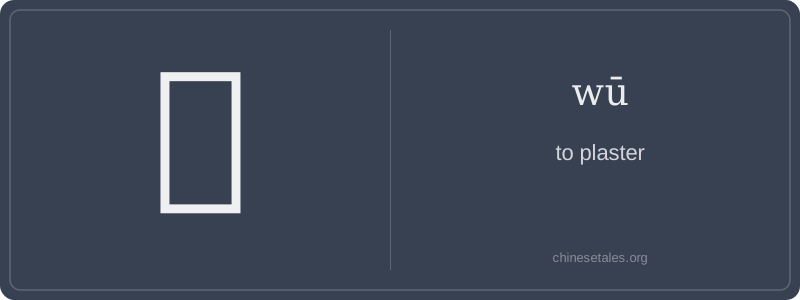
The earliest form of 杇 appears in bronze inscriptions as a pictograph showing a hand holding a flat, rectangular tool pressing against a vertical surface—clearly a trowel at work on a wall. Over time, the ‘hand’ component (扌) standardized on the left, while the right side evolved from a simplified depiction of the trowel + wall texture into the phonetic-semantic compound we see today: 扌 (hand action) + 烏 (wū, providing sound *and*, intriguingly, reinforcing visual weight—烏 is a heavy, black-feathered bird, echoing the dense, darkened sheen of freshly applied plaster).
By the Han dynasty, 杇 was firmly established in technical texts like the *Kaogong Ji* (Records of Crafts), where plastering walls was described as essential for weatherproofing and ritual purity in ancestral halls. The character’s visual duality—precision (the hand) and material density (the 烏’s weight and darkness)—mirrors its dual function: both practical sealing and symbolic smoothing of boundaries between human space and chaos. Even today, when artisans say ‘一杇定乾坤’, they’re invoking this ancient idea: one perfect stroke of plaster sets the whole world in order.
Let’s get tactile: 杇 (wū) isn’t about abstract ideas—it’s the gritty, hands-on act of smoothing wet plaster onto walls with a trowel. Think of the *shush-shush* sound of a mason’s steel blade gliding over lime mortar—this character embodies that physical, rhythmic labor. It’s a verb, always transitive, and almost exclusively used in formal, technical, or literary contexts (you’ll never hear it in casual chat like 'I plastered my bathroom'—that’s 塗 or 刷). Its core feel is artisanal, precise, and slightly archaic.
Grammatically, 杇 takes a direct object—the surface being plastered—and often appears in compound verbs or passive constructions. You’ll see it in phrases like 杇牆 (wū qiáng, ‘to plaster a wall’) or in classical-style descriptions: ‘工匠正專心杇壁’ (The craftsman is intently plastering the wall). Note: it doesn’t mean ‘to paint’ or ‘to wallpaper’—those are entirely different actions. Learners sometimes misread it as a noun (‘plaster’) or confuse it with homophones like 巫 (shaman), but 杇 is strictly a verb of skilled manual application.
Culturally, 杇 carries quiet dignity—it’s tied to craftsmanship, building integrity, and even Confucian ideals of meticulousness (think of the Analects’ emphasis on ‘perfecting the vessel before filling it’). A common mistake? Assuming it’s interchangeable with 抹 (mǒ, ‘to wipe/smear’)—but 抹 is broad and informal; 杇 implies professional, even ritual-grade surface refinement. In modern usage, it survives mostly in construction terminology, classical allusions, and poetic descriptions of restoration.