朿
Character Story & Explanation
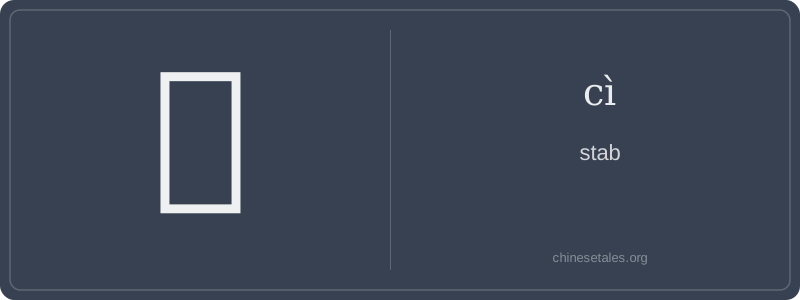
Carved onto oracle bones around 1200 BCE, 朿 began as a vivid pictograph: a tree trunk (木) sprouting two sharp, upward-pointing thorns — not branches, but *weapons grown from wood*. In bronze inscriptions, those thorns sharpened into distinct diagonal strokes (丿丿), while the trunk solidified into the 木 radical at the bottom. Over centuries, the upper part simplified from a more complex forked glyph to just two clean, separated strokes — no connecting line, no curve, just raw, unadorned pointiness. Stroke order confirms its nature: first the left thorn (丿), then the right (丿), then the three strokes of 木 — literally building the threat *on top of* the tree.
This wasn’t just botanical observation — it was embodied danger. In the *Shuō Wén Jiě Zì* (121 CE), China’s first dictionary, Xu Shen defined 朿 as ‘cì’ (to stab), explicitly linking its form to ‘wooden thorns that pierce’. Classical texts used it almost exclusively within compound characters: 棘 (jí) combined two 朿 over 木 to mean ‘dense thornbush’ — a natural barrier against invaders. Even today, when you see the double-thorn motif in characters like 立 + 朿 = 竿 (gān, ‘pole’ — originally a pointed staff), you’re touching the same ancient logic: wood made dangerous by purposeful sharpness.
Meet 朿 — a tiny, spiky relic from China’s earliest writing system. Forget modern ‘stab’ as a verb; this character is all about *sharp, piercing danger* — the kind you see in thorns, barbs, or a sudden, pointed attack. Its core feeling is visceral and physical: think of stepping barefoot on a rose bush or feeling the prickle of a porcupine quill. It’s not abstract violence — it’s *pointed intrusion*. That’s why it almost never stands alone in modern speech; it’s a fossilized root, buried deep inside more common characters like 刺 (cì, ‘to stab’) and 棘 (jí, ‘thornbush’).
Grammatically, 朿 is functionally extinct as an independent word — you won’t find it in dictionaries as a standalone lexical item, nor will it appear on menus or street signs. But its ghost animates dozens of words: every time you say 刺激 (cìjī, ‘stimulate’), you’re invoking 朿’s original ‘piercing force’. Learners often mistakenly try to use 朿 like a verb (e.g., *‘wǒ yào cì tā’*) — but that’s wrong! You must use 刺 instead. The six-stroke 朿 is purely a component, a silent ancestor whispering sharpness into its descendants.
Culturally, 朿 embodies how Chinese script preserves meaning through visual DNA. Its shape hasn’t changed much in 3,200 years — a rare stability. Modern learners’ biggest trap? Confusing it with 束 (shù, ‘to bind’) or 易 (yì, ‘easy’) due to superficial stroke similarities. But 朿 has *no horizontal bar across the top* — just two upward slashes, like twin thorns breaking through wood. That absence is everything: no binding, no ease — only piercing intent.