朏
Character Story & Explanation
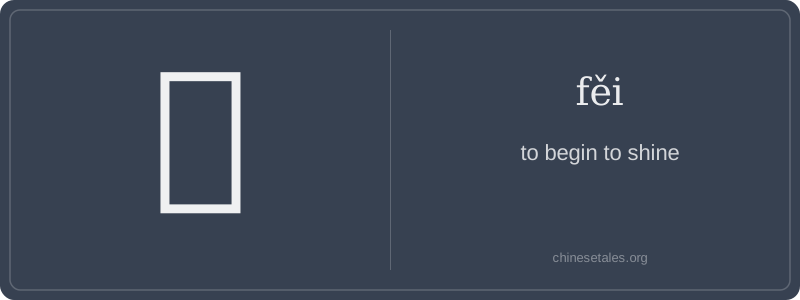
The earliest form of 朏 appears in bronze inscriptions as a combination of 月 (moon, as a pictograph of a crescent) and the phonetic component 弗 (fú), which originally depicted a bent rod or restraining stick — not a negation sign here, but a sound clue. Over centuries, the moon radical simplified from a full crescent enclosure to the modern 月 shape, while 弗 lost its top horizontal stroke and evolved into today’s clean, angular form. Crucially, the original 弗 was *not* functioning as 'not' — that semantic shift happened elsewhere — making 朏 a rare case where a 'negation-looking' component contributes only pronunciation.
This character first appeared in the Book of Documents (Shūjīng) and was later codified in astronomical treatises like the Records of the Grand Historian, where ‘朏’ specifically marked the third day of the lunar month — the moment when the moon’s faint light became visible to the naked eye. Its visual structure quietly mirrors its meaning: the moon radical announces the subject, while 弗’s crisp, upright strokes evoke the sharp, slender edge of that first visible sliver — not soft glow, but defined emergence. No wonder poets like Li Bai used it sparingly: one 朏 could anchor an entire poem in cosmic stillness.
朏 (fěi) is a poetic, almost reverent word for the very first sliver of moonlight — not just 'shining', but the delicate, hesitant emergence of luminance after darkness. It carries a sense of quiet awe and temporal precision: not any light, but the *first* light of the lunar cycle, traditionally observed on the third day after new moon. In classical Chinese, it’s never used casually — you won’t hear it in weather reports or texting. It lives in poetry, almanacs, and ritual texts, where timing and celestial harmony matter deeply.
Grammatically, 朏 functions almost exclusively as a noun or time noun — like saying 'the Third Night' in English — and rarely appears alone in modern speech. You’ll see it in phrases like ‘朏日’ (fěi rì, 'the day of the first crescent') or embedded in compound time expressions. Learners often mistakenly treat it as a verb ('to shine'), but it doesn’t take aspect markers (了, 过) or objects. It’s more like a proper noun for a celestial moment — think 'Dawn’s First Light' capitalized, not 'to dawn'.
Culturally, 朏 reveals how intimately Chinese cosmology ties human rhythm to cosmic cycles: the lunar month wasn’t just measured — it was *witnessed*, with precise names for each phase’s spiritual weight. Mistaking 朏 for a generic brightness word misses its sacred specificity. Also, its near-total absence from spoken Mandarin means learners who memorize it for HSK will be disappointed — but those who encounter it in Tang poetry or Daoist texts will feel they’ve glimpsed an ancient, shimmering secret.