曷
Character Story & Explanation
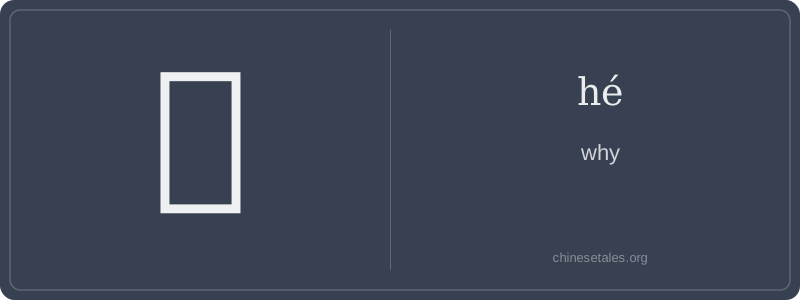
The earliest form of 曷 appears on Western Zhou bronze inscriptions as a compound pictograph: a mouth (口) beneath a stylized head or face (originally resembling a simplified person with exaggerated eyes and mouth), all enclosed in a rounded frame suggesting speech or utterance. Over centuries, the top evolved into 曰 (yuē, 'to speak'), while the lower part condensed from 口 + 人 into 止 (zhǐ, 'to stop') — not as 'stopping', but as a phonetic loan symbolizing finality or questioning pause. By the seal script era, the shape stabilized into today’s nine-stroke form: 曰 atop 止, with the horizontal stroke of 止 subtly elongated to balance the upper enclosure.
This visual evolution mirrors its semantic journey: from depicting 'a speaking mouth questioning reality' to crystallizing as the quintessential classical interrogative particle. In the Book of Songs (Shījīng), 曷 appears over 30 times — often opening laments like 曷日而亡?('On what day will [this sorrow] end?'), where it doesn’t just ask 'when', but conveys existential urgency. Its form — 曰 (speech) over 止 (a grounded, decisive base) — visually enacts the act of halting speech to pose a fundamental question: language pausing to confront meaning itself.
曷 (hé) is the ancient, elegant cousin of modern 为什么 (wèi shén me) — a single-character 'why' that still breathes in classical texts, poetry, and formal rhetoric. It doesn’t shout; it leans in with quiet gravity, carrying the weight of inquiry, doubt, or even rhetorical challenge ('How could this be?'). You’ll rarely hear it in daily chat — but you’ll spot it in Tang dynasty poems, Confucian Analects quotations, or legal documents quoting precedent. Its tone is literary, slightly archaic, and always intentional: using 曷 instead of 为什么 signals that you’re invoking tradition, precision, or stylistic control.
Grammatically, 曷 functions as an interrogative pronoun — like 'what' or 'why' — but only in subject or object position within classical syntax. It often appears at the start of a clause, sometimes paired with 乎 or 哉 for emphasis: 曷不归乎?('Why not return?'). Crucially, it never stands alone as a full question like 'Why?' in English; it’s embedded, almost musical, requiring the surrounding structure to land. Learners mistakenly treat it like a drop-in synonym for 为什么 — but dropping 曷 into a modern sentence without adjusting verb aspect, particles, or word order sounds jarringly anachronistic, like quoting Shakespeare at a coffee run.
Culturally, 曷 embodies the Chinese tradition of questioning through restraint. It’s not impulsive curiosity — it’s reflective, contextual, often implying moral or cosmic stakes ('Why *this* suffering?', 'Why *now*?'). A common pitfall? Confusing it with the homophone 何 (hé), which is broader ('what/why/how') and far more frequent. 曷 is rarer, narrower, and always carries a faint echo of lament or solemn wonder — think of it as the 'why' you whisper under your breath after reading a tragic poem, not the one you yell when your phone won’t charge.