曈
Character Story & Explanation
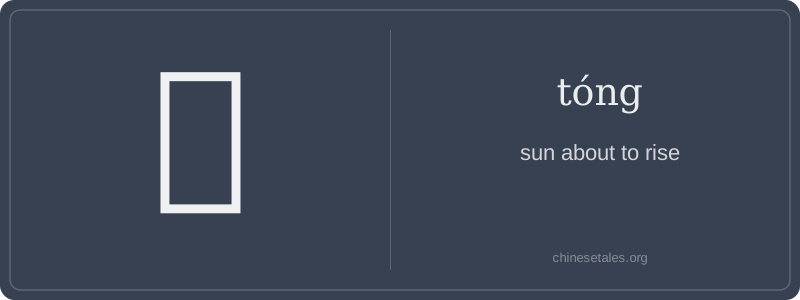
The character 曈 first appeared in seal script (around 200 BCE), not oracle bone — too late for that era. Its left side, 日 (rì, 'sun'), is unmistakable: a square box representing the solar disc. The right side, 童 (tóng, 'child'), evolved from an ancient pictograph of a child with exaggerated head and bare feet — later stylized into today’s 12-stroke form. Crucially, the ‘child’ component isn’t literal here; it serves as a phonetic loan, hinting at pronunciation (tóng) while visually anchoring the sense of newness, innocence, and beginning — like the first breath of daylight.
This dual structure — sun + ‘child’ — crystallized its meaning in Han dynasty texts: not just light, but *nascent* light, tender and unformed. In Du Fu’s poetry, 曈 appears in lines evoking dawn’s gentle arrival, always paired with words like 曈昽 (soft radiance) or 旭曈 (rising sun’s first gleam). Its visual rhythm — sun rising over youth — became synonymous with renewal itself. Even today, calligraphers linger on the balance between 日’s compact weight and 童’s flowing strokes, mirroring how dawn balances stillness and motion.
Imagine standing on a mountain ridge just before dawn — the sky is still deep indigo, but a faint, warm glow bleeds along the eastern horizon. That hushed, expectant moment when night hasn’t quite released its grip but day is already whispering through the mist? That’s 曈 (tóng). It doesn’t mean ‘sunrise’ — that’s 日出 (rìchū). It means the *sun about to rise*, the luminous pre-dawn shimmer that gilds the edges of clouds and turns dewdrops into tiny lanterns. It’s poetic, intimate, and deeply atmospheric — you’ll almost never hear it in casual speech or news reports.
Grammatically, 曈 appears almost exclusively in literary compounds like 曈昽 (tóng lóng) or 旭曈 (xù tóng), usually as part of a reduplicated or paired adjective describing light quality. You won’t say ‘the sun is 曈’ — instead, you’d write ‘晨光曈昽’ (chén guāng tóng lóng) — ‘dawn light is soft and radiant’. It’s always descriptive, never standalone; trying to use it as a verb or noun alone will sound jarringly archaic or unnatural.
Culturally, 曈 carries the quiet reverence of classical Chinese nature poetry — think Tang dynasty poets watching the world hold its breath before light arrives. Learners often mistakenly treat it like a general ‘sun’ or ‘light’ character (confusing it with 明 or 阳), but 曈 is *only* about that precise, fleeting threshold between dark and day. Its rarity outside poetry means encountering it feels like finding a sealed letter from Li Bai — beautiful, meaningful, and best appreciated slowly.