曀
Character Story & Explanation
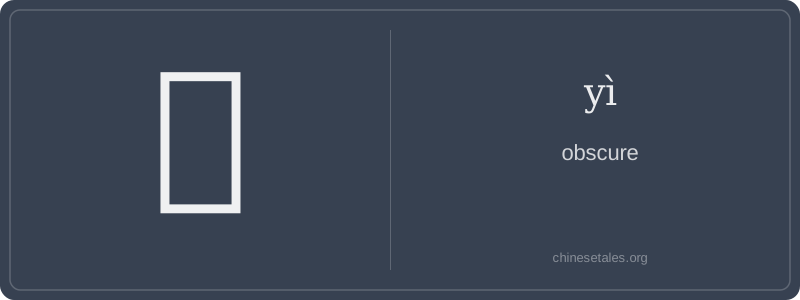
Oracle bone inscriptions don’t preserve 曀 — it first appeared in bronze script during the late Zhou dynasty as a compound pictograph: the top was 彐 (jì), a stylized depiction of hands holding a covering, and the bottom was 日 (rì, 'sun'). Over centuries, 彐 evolved into the top radical (a variant of 彐), while the sun 日 remained intact — visually, two hands pulling a veil across the sun. By the Han dynasty clerical script, the form had stabilized into today’s structure: + 日 — literally 'veiled sun'.
This image directly shaped its meaning: not mere darkness, but *active occlusion* — something dense and tangible blocking light. The Shijing (Book of Songs) uses 曀 in Ode 242: '曀曀其阴,虺虺其雷' ('The sky grows ever more obscured; thunder rumbles low'), evoking imminent, brooding weather. Later, Tang poets like Du Fu employed it to mirror inner turmoil — the external haze mirroring moral or political obscurity. Even today, its shape remains a perfect visual metaphor: a sun smothered by unseen weight.
At its heart, 曀 (yì) is a poetic, almost atmospheric word — not just 'obscure' in the abstract sense, but specifically describing skies thick with dust, smoke, or heavy cloud that blots out the sun and dims the world. Think less 'confusing idea' and more 'a suffocating, grey-brown haze swallowing the mountains'. It’s deeply visual and sensory: native speakers instantly picture that oppressive stillness before a sandstorm or after a wildfire.
Grammatically, 曀 is almost always used as an adjective — but unlike common adjectives like 大 or 小, it rarely stands alone. You’ll find it in classical-style phrases or literary descriptions, often paired with nouns like 天 (sky), 日 (sun), or 光 (light). It never takes degree adverbs like 很 or 非常 — saying *很曀 is unnatural. Instead, it appears in fixed patterns: 曀然 (yì rán, 'suddenly obscured'), 曀晦 (yì huì, 'gloomy and dim'), or as a verb-like modifier: 天色曀 (the sky turns obscure).
Culturally, 曀 lives in classical poetry and historical texts — you won’t hear it in daily chat or news broadcasts. Learners sometimes misread it as 易 (yì, 'easy') due to the shared top component, or confuse it with 晦 (huì, 'gloomy') — but 曀 carries stronger connotations of physical obstruction and density. Its rarity means encountering it feels like unearthing a sealed scroll: rewarding only if you appreciate linguistic texture over utility.