暨
Character Story & Explanation
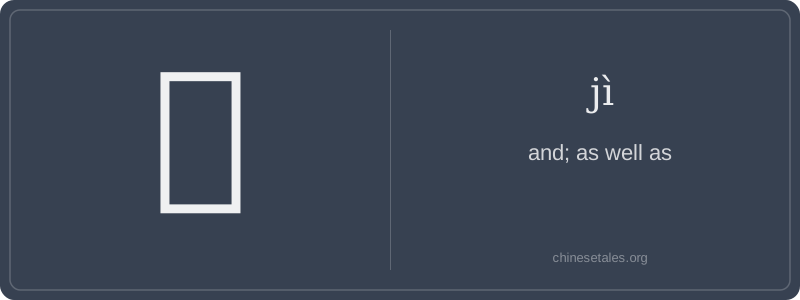
The earliest form of 暨 appears in late Warring States bamboo texts as a complex character combining 日 (sun/day) on top with 旡 (jì, an archaic variant meaning 'to finish, cease') below — not the modern 既. Oracle bone inscriptions don’t contain it, but bronze script shows 日 above a kneeling figure holding a vessel, evolving into 旡 (depicting a person turning away after finishing a ritual libation). Over centuries, 旡 simplified and fused with 日, while the lower component was later misanalyzed as 既 (jì) due to visual similarity — hence the modern shape: 日 + 既 (though etymologically unrelated to 既’s 'already' meaning).
This origin reveals its core idea: 'joining at the point of completion' — a ritual synchronization, not just addition. In the Zuǒ Zhuàn (c. 4th century BCE), 暨 appears in phrases like '暨于今' ('reaching up to now'), emphasizing temporal convergence. By the Han dynasty, its conjunctive sense solidified in inscriptions linking royal lineages or temple dedications — e.g., '孝文皇帝暨孝景皇帝' ('Emperor Xiaowen and Emperor Xiaojing'), where the 日 radical subtly evokes shared calendrical authority and sovereign continuity. Its visual weight (14 strokes, balanced symmetry) mirrors its function: binding equals with solemn parity.
Think of 暨 (jì) as the Chinese equivalent of the Latin 'et cetera' — formal, elegant, and slightly ceremonial. It means 'and; as well as', but unlike the humble 和 (hé) or the conversational 还有 (hái yǒu), 暨 belongs to the realm of official documents, academic titles, and grand announcements — like the 'and' in 'President Biden and Vice President Harris' on a White House press release. It’s not for texting your friend about lunch plans; it’s for naming university conferences ('2024 International AI Symposium暨Ethics Forum') or listing co-sponsors on a government grant.
Grammatically, 暨 is a coordinating conjunction that links nouns, noun phrases, or proper names — never verbs or clauses. You’ll see it in titles, headings, and formal lists: 北京大学暨清华大学 (Běijīng Dàxué jì Qīnghuá Dàxué) — 'Peking University and Tsinghua University'. Crucially, it cannot start a sentence or stand alone like 'and' in English; it always appears *between* two equal elements. Learners often mistakenly substitute it for 跟 (gēn) or 与 (yǔ), but those carry different register and syntactic constraints — 跟 is colloquial and object-marking, while 与 is literary but can introduce agents in passive constructions; 暨 does neither.
Culturally, 暨 signals prestige and precision — its use implies the items joined are equally weighty and formally recognized. Misusing it (e.g., saying 'I ate rice 暨 vegetables') instantly marks you as either translating too literally from English or imitating bureaucratic jargon. It’s also easily misread: its 日 (rì, 'sun/day') radical hints at time-based coordination (originally 'to join at a moment'), not mere enumeration — a nuance lost if you treat it as a plain 'and'.