暕
Character Story & Explanation
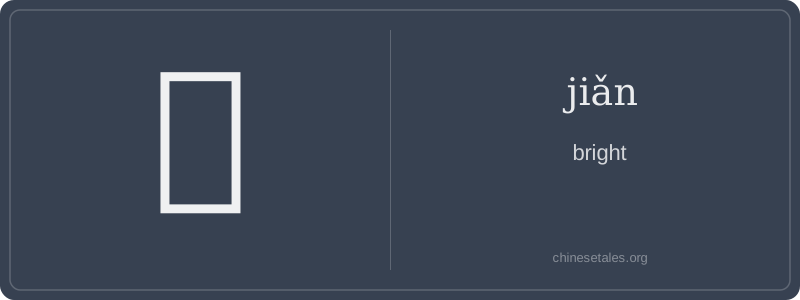
The character 暕 first appeared in seal script during the Warring States period — not earlier oracle bones — and its structure tells a vivid story. Its left radical 日 (rì, 'sun') anchors it in celestial phenomena, while the right component is a stylized form of 兗 (yǎn), an ancient place name that evolved graphically into something resembling 佥 (qiān), but with crucial visual nuance: three horizontal strokes above a closing frame, suggesting 'contained radiance' rather than scattered light. Over centuries, clerical script simplified the right side’s curves into clean angular lines, and regular script finalized the balance: sun on the left, disciplined luminosity on the right.
This visual composition mirrors its semantic evolution. In early classical texts like the *Guwen Guanzhi*, 暕 described the steady, unblinking light of a full moon — not dazzling glare, but calm, revealing illumination. By the Tang dynasty, poets like Li Bai used it metaphorically: 'her wisdom 暕如秋水' ('her wisdom shines clear as autumn water'), linking brightness to perceptual depth and moral transparency. The character never meant 'flashy' or 'loud'; its etymology insists on brightness that is measured, integrated, and ethically resonant — a sun that doesn’t burn, but reveals.
At first glance, 暕 (jiǎn) seems straightforward — 'bright', 'luminous', even 'radiant'. But here’s the twist: it’s almost never used alone in modern Mandarin. Unlike common brightness words like 明 (míng) or 亮 (liàng), 暕 lives a quiet, poetic life — reserved for classical allusions, literary metaphors, and compound words where it adds elegance, not utility. Native speakers don’t say *'This room is 暕'* — they’d say *'This room is 明亮 (míngliàng)'*. 暕 evokes a specific kind of brilliance: serene, enduring, almost moral — think of sunlight at dawn breaking over misty mountains in a Song dynasty scroll painting.
Grammatically, 暕 functions almost exclusively as a morpheme inside two-character compounds (e.g., 暕洁 jiǎnjié 'pure and radiant'). It rarely appears as a standalone adjective or verb, and never as a verb like 'to brighten'. Learners who try to use it like 明 (e.g., *tā hěn 暕*) will sound archaic or unintentionally comical — like quoting Confucius at a coffee shop. Even in formal writing, it’s chosen deliberately for its tonal weight and visual grace, not semantic necessity.
Culturally, 暕 reflects the Chinese aesthetic preference for layered meaning: brightness isn’t just physical light — it’s clarity of mind, purity of intention, integrity shining through action. That’s why it appears in names (e.g., historical figures like 萧暕 Xiāo Jiǎn) and philosophical texts describing virtuous rulers whose virtue 'shines forth' without force. The biggest mistake? Assuming it’s a synonym you can swap in for 亮. It’s not — it’s a brushstroke, not a flashlight.