晬
Character Story & Explanation
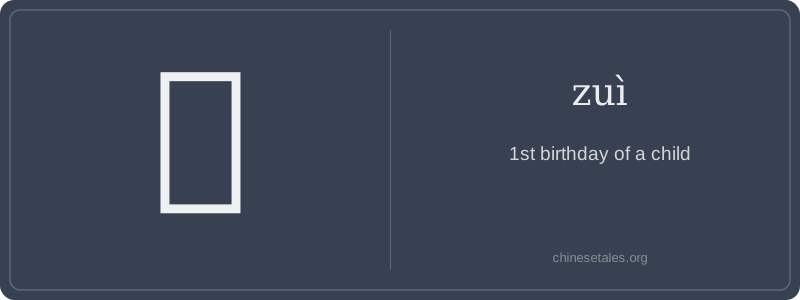
The earliest form of 晬 appears in Han dynasty seal script — not oracle bone, but already highly stylized. Visually, it’s a brilliant fusion: the left side 日 (rì, 'sun/day') anchors it in time, while the right side 卒 (zú, 'to end/completion') originally depicted a person with bound hands and a head covered by a ceremonial cloth — symbolizing ritual completion. Over centuries, 卒 simplified from a complex figure into today’s 8-stroke shape, while 日 stayed crisp and solar. Crucially, the two components aren’t arbitrary: together, they whisper 'the day when the first year completes' — not death, but fullness, like the sun completing its first annual circuit over the child’s life.
This meaning crystallized during the Northern Song dynasty, appearing in Sima Guang’s *Family Rituals*, where 晬日 is prescribed as the precise day for presenting offerings to ancestors and performing the object-selection rite. By the Ming and Qing dynasties, 晬 became synonymous with auspicious beginnings — poets used it to evoke innocence, potential, and celestial harmony. Its visual duality is poetic: 日 suggests light and clarity; 卒, though now associated with 'death' in modern usage, here retains its older sense of 'culmination' — making 晬 literally 'the sun’s completion', i.e., the first full solar year of life.
At its heart, 晬 (zuì) is a tender, time-bound word — it doesn’t mean 'birthday' in general, but *only* the child’s very first birthday, a single-day milestone steeped in classical Chinese ritual and familial reverence. The character feels poetic and archaic: you’ll almost never hear it in casual speech or modern media — it lives in literary essays, historical novels, baby naming ceremonies, and grandparents’ blessings. Grammatically, it’s a noun that almost always appears in fixed phrases like 晬盘 (zuì pán) or 晬日 (zuì rì), rarely standing alone. You won’t say 'My son is zuì' — instead, you’d say 'Today is his 晬日' or 'We held the 晬盘 ceremony.'
Learners often mistakenly treat 晬 as a general term for 'first birthday' in spoken Mandarin — but native speakers instantly flag it as overly formal or even quaint. It’s not wrong — just like saying 'verily' instead of 'really' — but context is everything. Using it in a WeChat message to friends would raise eyebrows; using it in a calligraphy scroll for a newborn? Perfect. Also, avoid confusing it with common birthday words like 生日 (shēng rì) — 晬 carries weight, ritual, and ancestral continuity.
Culturally, 晬 ties directly to the ancient 'one-year divination' custom: on the baby’s first birthday, objects (a writing brush, coin, abacus, etc.) were laid out — the item the child grasped first was believed to foretell their future path. This ceremony, called 晬盘, is where 晬 truly shines. Modern parents sometimes revive it playfully, but the character itself remains a linguistic heirloom — preserved not by frequency, but by reverence.