晜
Character Story & Explanation
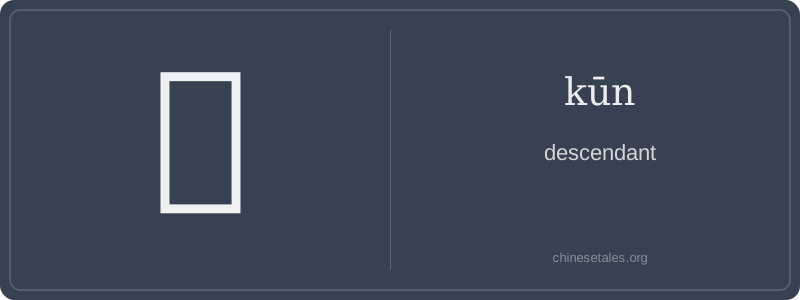
The earliest form of 晜 appears on Western Zhou bronze inscriptions as a compound pictograph: the left side was a simplified 'sun' (日) or possibly an early variant of 光, while the right was a kneeling human figure (卩) with extended arms — symbolizing ritual submission and continuity before ancestral light. Over centuries, the 'sun' morphed into 日, then merged stylistically with the phonetic component 昆 (which provided the kūn sound but no semantic link), and the kneeling figure hardened into the modern 口 + 卩 shape. By the Han dynasty, the character stabilized as 晜 — a visual fossil preserving both reverence and lineage.
This character flourished in the Spring and Autumn period, especially in clan-based oaths and ancestral temple dedications, where naming descendants precisely affirmed legitimacy and succession rights. In the *Book of Rites* (*Liji*), 晜 appears in contexts like '晜孫承祀' ('the descendant-grandson inherits the ancestral sacrifices'), underscoring its liturgical gravity. Its decline began after the Tang dynasty, as vernacular language favored broader terms — yet its visual form remains a silent testament to how intimately ancient Chinese tied identity to solar symbolism (日) and embodied deference (卩).
Meet 晜 (kūn) — a ghost of classical Chinese, haunting the margins of dictionaries but rarely seen in modern speech or writing. Its core meaning is 'descendant' or 'younger male relative in the same lineage', carrying the quiet weight of ancestral continuity and Confucian kinship hierarchy. Unlike common terms like 子孙 (zǐsūn) or 后代 (hòudài), 晜 is hyper-specific: it denotes a *male-line junior descendant* — think grandson, great-grandson, or even more distant patrilineal heirs — and appears almost exclusively in pre-Qin bronze inscriptions, Han dynasty genealogical records, and classical poetry where precision in familial rank mattered deeply.
Grammatically, 晜 functions as a noun and never stands alone in modern usage; you’ll only encounter it embedded in formal compounds (like 晜孫 or 玄晜) or archaic literary phrases. Learners won’t find it on signs, menus, or WeChat — and that’s intentional: it’s functionally obsolete in spoken Mandarin and absent from HSK. A common mistake? Assuming it’s related to 昆 (kūn, 'brother' or 'many') because of identical pronunciation — but they share no etymological root, and confusing them breaks classical syntax entirely.
Culturally, 晜 embodies the meticulousness of ancient Chinese kinship taxonomy: where English says 'descendant', classical Chinese had over a dozen precise terms distinguishing paternal vs. maternal line, seniority, gender, and generational distance. Using 晜 today signals either deep classical literacy or deliberate archaism — like quoting Chaucer in a text message. It’s not 'wrong' to ignore it — but knowing it unlocks layers of meaning in texts like the *Zuo Zhuan* or ancestral stele inscriptions.