晗
Character Story & Explanation
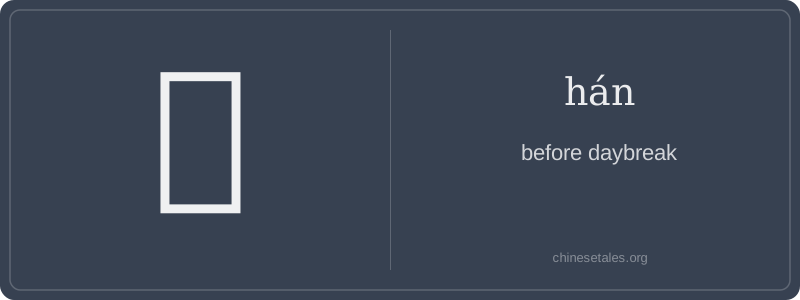
The earliest form of 晗 isn’t found in oracle bones — it’s a later creation, likely Han dynasty or after, designed as a semantic-phonetic compound. Visually, it combines 日 (rì, 'sun', radical) on the left with 含 (hán, 'to hold in mouth; contain') on the right — both sharing the same pronunciation. The original seal script showed 日 firmly anchored left, while 含 evolved from a pictograph of a mouth (口) cradling something (今), suggesting containment. By the Tang dynasty, the structure stabilized: 11 strokes total — four for 日, seven for 含 — with the right component’s ‘mouth’ (口) neatly closed around the ‘now’ (今) element, visually echoing the idea of 'holding the moment before daybreak.'
This wasn’t a pictograph of nature, but a brilliant conceptual fusion: the sun (日) is *contained*, *held back*, *not yet risen* — just as one holds breath or words in the mouth (含). Classical poets like Li Bai didn’t use 晗 much, but Song dynasty literati embraced it for its subtle tension. In Ming-Qing poetry, 晗光 appears alongside 寒露 (cold dew) and 残月 (waning moon) to mark that fragile, silent threshold — where the world hasn’t woken, but the sun is already ‘held’ behind the horizon, waiting to be released.
晗 is a poetic, literary character that evokes the hushed, liminal magic of the hour just before dawn — not quite night, not yet day. It’s not about brightness or light itself (that’s 明 or 曦), but about the *anticipation* of light: the sky softening, stars fading, birds stirring faintly. You’ll rarely hear it in casual speech; it lives in classical poetry, names (especially given names), and lyrical prose. Its core feeling is quiet expectancy — like holding your breath before sunrise.
Grammatically, 晗 functions almost exclusively as a noun or time noun (e.g., 晗时 'the hour of 晗'), never as a verb or adjective. It doesn’t take aspect particles (了, 过) or modifiers like 很 — you wouldn’t say *很晗* or *晗了*. Instead, it appears in fixed temporal phrases: 晗光 (dawn’s first light), 晗色 (pre-dawn hue), or in compound names like 李晗 or 晗玥. Think of it as a 'time fossil' — grammatically frozen in elegance.
Culturally, learners often misread 晗 as 'early morning' (like 早晨), but it’s far more precise and atmospheric — strictly pre-sunrise, when darkness still has weight. Confusing it with 晨 (chén, 'morning') is common, but 晨 covers the entire morning hours, while 晗 is a five-to-ten-minute window. Also, its radical 日 (sun) isn’t ironic — it signals the sun’s imminent arrival, not its presence. And yes, its rarity means even many native speakers pause to recall its exact nuance!