晏
Character Story & Explanation
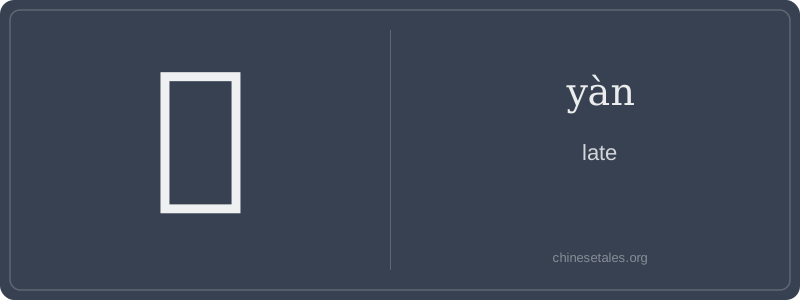
The earliest form of 晏 appears in bronze inscriptions as a stylized sun (日) above a simplified human figure (亼, an ancient variant of 人) seated calmly beneath it — not running, not hiding, but resting in prolonged daylight. Over centuries, the lower part evolved: 亼 fused with 安 (ān, 'peace') — hence the modern bottom half 安, which itself combines 宀 (roof) and 女 (woman), suggesting sheltered serenity. The ten strokes crystallized into today’s balanced structure: 日 on top (5 strokes), 安 below (5 strokes) — a perfect visual metaphor for 'sun lingering peacefully in place.'
This calm persistence shaped its semantic journey. In the Book of Songs (Shījīng), 晏 appears in lines like '言笑晏晏' (yán xiào yàn yàn), describing gentle, unhurried laughter — not loud mirth, but serene, drawn-out joy. Later, in Han dynasty texts, it acquired the sense of 'late' specifically in relation to ritual timing: when the sun had settled, when guests had stayed long, when affairs had extended beyond the expected hour. Its visual symmetry — sun + peace — thus encodes a profound cultural idea: lateness isn’t stress; it’s the quiet dignity of time fully inhabited.
At first glance, 晏 (yàn) means 'late' — but not in the rushed, apologetic way we say 'I’m late!' in English. In Chinese, it carries a quiet, almost dignified weight: think 'the sun has lingered past noon,' or 'the banquet stretched into the evening.' It evokes stillness, slowness by choice — not failure to be punctual. You’ll rarely hear it in casual speech ('I’m late for class!'), but frequently in classical poetry, historical texts, and formal writing where timing is measured against natural or ritual rhythms.
Grammatically, 晏 is almost always an adjective (never a verb), and it modifies nouns or predicates directly — no particles like 了 or 过 needed. You’ll see it in phrases like 天色已晏 (tiān sè yǐ yàn, 'the sky has grown late'), where it describes a state of advanced time, often with a tinge of melancholy or solemnity. Learners mistakenly try to use it like 晚 (wǎn), but while 晚 is neutral and everyday (晚上, 晚到), 晏 feels literary, even archaic — dropping it into a WeChat message would sound like quoting a Tang dynasty poem at brunch.
Culturally, 晏 reveals how deeply Chinese thought links time with light, order, and propriety. Its radical 日 (sun) roots it in celestial observation; its meaning implies a deviation from the ideal — not chaos, but a graceful, inevitable drift toward dusk. A common error is overgeneralizing it to mean 'late' in all contexts (e.g., saying *我晏到了* instead of 我来晚了). That mistake doesn’t just sound odd — it subtly shifts your tone from 'I arrived late' to 'I have entered the hushed, ceremonial twilight of arrival.'