昫
Character Story & Explanation
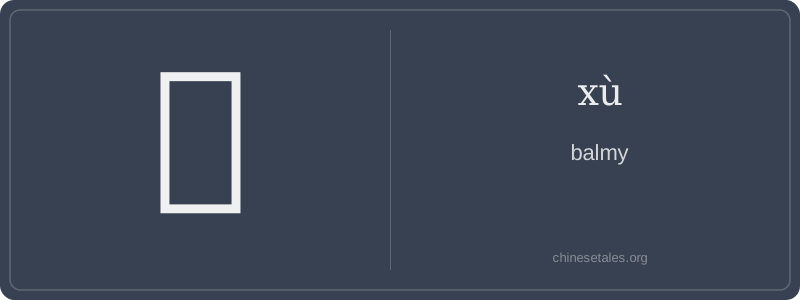
The earliest form of 昫 appears in Han dynasty seal script, evolving from a combination of 日 (rì, 'sun') on the left and 旭 (xù, 'rising sun') simplified on the right — but crucially, the right side was originally written as 亘 (gèn, 'to extend continuously'), which later stylized into the current 九 + 一 shape. Oracle bone inscriptions don’t contain 昫, but bronze script variants show 日 paired with a flowing, upward-curving line suggesting sustained, gentle radiation — like sunlight diffusing through morning mist rather than blazing at noon.
By the Tang and Song dynasties, 昫 solidified as a literary synonym for 'mild solar warmth', appearing in poetry anthologies and medical texts describing 'balmy qi circulation'. The famous Song physician Qian Yi used 昫 in his pediatric treatise to describe the ideal ambient warmth for infants — not hot, not cold, but just-so. Visually, the 日 radical anchors it in solar energy, while the right-hand component (a stylized 九 + 一) suggests 'nine units of steady, unbroken light' — echoing ancient numerology where nine symbolizes completeness and gentleness in Daoist cosmology.
Think of 昫 (xù) as the Chinese word for that first gentle warmth after winter — not hot, not sunny, but deeply comforting: a balmy breeze, soft light, or tender affection. It’s a poetic, literary character rarely used in daily speech; you’ll almost never hear it in casual conversation or HSK textbooks. Its core feeling is *mild, nurturing warmth* — physical, emotional, or even moral. Unlike common words like wēn (温, 'warm') or nuǎn (暖, 'warm/comforting'), 昫 carries elegance and quiet reverence, often evoking spring’s quiet arrival or a parent’s gentle gaze.
Grammatically, 昫 functions almost exclusively as an adjective — but it’s rarely standalone. You won’t say 'this weather is 昫'; instead, it appears in fixed literary compounds like 昫暖 (xù nuǎn) or in classical-style phrases such as '春阳昒昒,万物昒昫' (a poetic line from Ming-era texts). It can also appear in names or poetic titles, where its nine-stroke balance and 日 (sun) radical subtly reinforce its solar, life-giving connotation. Learners often misread it as xū (like 虚) or confuse it with 煦 — but 昫 is rarer, more delicate, and never means 'bright' or 'brilliant'.
Culturally, 昫 embodies a distinctly Chinese aesthetic ideal: warmth without intensity, presence without force. It reflects Daoist and Confucian values — harmony, moderation, and subtle influence. A common mistake is overusing it in modern writing; native speakers reserve it for lyrical contexts, calligraphy inscriptions, or names. Using 昫 in a WeChat message would sound like quoting a Tang poem at a coffee shop — beautiful, but wildly out of place!