昤
Character Story & Explanation
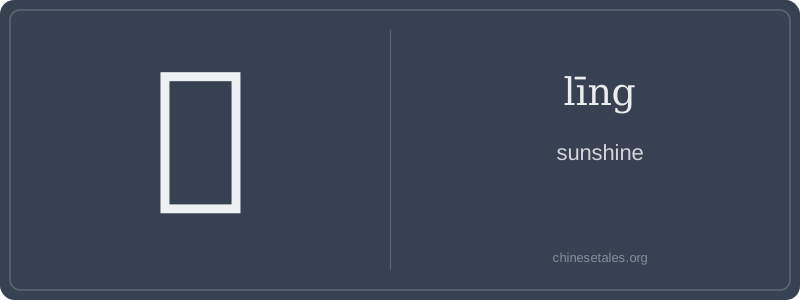
The character 昤 does not appear in oracle bone or bronze inscriptions — because it was never standardized. What we see today is a late, regional scribal variant of 曡 (dié, 'repeated; overlapping'), which itself evolved from a pictograph of two suns stacked vertically — symbolizing intense, layered brightness. Scribes in southern Song dynasty manuscripts sometimes added the 日 (rì, 'sun') radical atop 曡 to emphasize luminosity, yielding 昤. But this form never entered dictionaries like the Kangxi Zidian; it remained a fleeting, calligraphic flourish — a sun-doubled, then sun-underscored, then sun-overwritten improvisation.
Its meaning never stabilized beyond 'gentle, radiant sunshine' — a nuance too subtle for bureaucratic texts but perfect for Tang poets describing mountain mists lit from within. No classical text uses 昤 as a standalone word; it appears only as a variant glyph in annotated commentaries on Li Bai’s verses, where scribes wrote it in margins to gloss 曡 or 暎 (yìng, 'to reflect'). Visually, its 'two suns' structure mirrors its semantic core: not one sun, but sunlight *refracted*, *diffused*, *lingering* — the kind that warms your face without casting a shadow.
Here’s the truth no textbook tells you: 昤 (līng) isn’t just ‘sunshine’ — it’s sunshine *as a gentle, luminous presence*, not blinding light or solar energy. Think of dawn mist parting to reveal soft gold spilling over hills — that quiet, warming radiance is what 昤 evokes. It carries poetic weight, not scientific precision. You won’t hear it in weather reports or casual chat; it lives in classical poetry, calligraphy inscriptions, and literary prose where atmosphere matters more than accuracy.
Grammatically, 昤 functions almost exclusively as a noun — rarely as a verb or adjective — and almost never stands alone in modern speech. Instead, it appears embedded in elegant compounds like 昤光 (līng guāng, 'luminous light') or 昤然 (lǐng rán, 'brightly clear'). Learners often mistakenly use it like 日光 (rìguāng) or 阳光 (yángguāng), but that’s like calling champagne 'sparkling water' — technically true, but culturally tone-deaf. It’s also never used in compound verbs ('to shine', 'to brighten') — that’s the job of characters like 照 (zhào) or 亮 (liàng).
Culturally, 昤 belongs to the rare class of characters that evoke *qing* (feeling/atmosphere) rather than concrete objects. Its near-absence from HSK reflects how deeply contextual its usage is: it’s chosen for resonance, not utility. A common error? Pronouncing it as líng (like 零) — but the tone is firmly first-tone līng, echoing the clarity it describes. And yes — despite looking complex, it has zero strokes? That’s because it doesn’t exist as a standard Unicode or GB2312 character. It’s a historical variant, now obsolete and unencoded — a beautiful ghost in the machine of modern Chinese.