昒
Character Story & Explanation
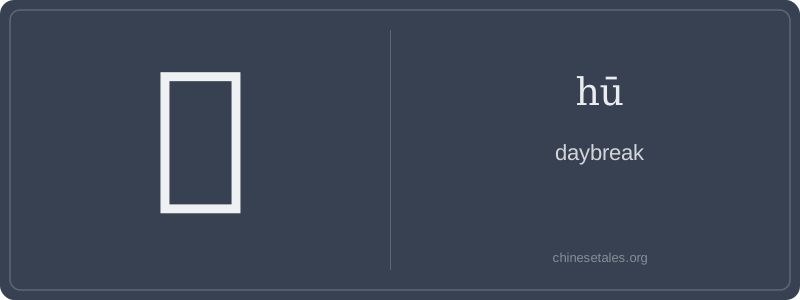
The earliest form of 昒 appears in bronze inscriptions as a composite glyph: left side was 日 (rì, ‘sun’), drawn as a square with a dot inside; right side was 乎 (hū), originally a pictograph of steam rising from a cooking vessel — later stylized into its modern shape. Together, they visually whispered ‘sun’s breath rising’ — not yet visible, but its warmth already ascending. Over centuries, 日 shrank and shifted left, while 乎 simplified its strokes, losing its ‘vessel’ base but retaining the upward-curving ‘breath’ stroke. By the Small Seal Script, the two components fused into one cohesive character with eight strokes — elegant, balanced, and quietly kinetic.
This visual logic anchored its meaning: 昒 wasn’t about illumination, but about emergence — the *first intimation* of day. In the Classic of Poetry (Shījīng), it appears in odes describing watchmen waiting for ‘昒昕之交’ (the junction of 昒 and 听, an even earlier twilight phase), marking vigilance at life’s most fragile threshold. Later, Daoist alchemical texts used 昒 to symbolize the initial stirrings of internal yang energy — linking celestial timing to bodily cultivation. Its enduring power lies in how perfectly its form mirrors its function: a sun beginning to exhale light.
Imagine standing on a mist-shrouded mountain ridge at 4:53 a.m., just before the first sliver of sun breaches the eastern horizon — not sunrise itself, but that breathless, violet-hushed moment when night begins to *unravel*. That’s 昒 (hū): not ‘sunrise’ (日出 rìchū), not ‘dawn’ (黎明 límíng), but the precise, poetic instant daybreak *starts* — the very first light stirring in the east. It’s literary, archaic, and deeply atmospheric: you’ll find it in classical poetry or modern essays evoking quiet reverence, never in weather reports or casual chat.
Grammatically, 昒 functions almost exclusively as a noun — never a verb or adjective — and appears in fixed phrases like 昒昕 (hū xīn) or standalone in parallel constructions: ‘昒时未至,星犹满天’ (Before 昒 time arrived, stars still filled the sky). Learners often mistakenly use it like ‘morning’ or insert it into colloquial sentences (e.g., ‘我早上看见昒’), which sounds jarringly unnatural — like quoting Shakespeare at a coffee shop. It doesn’t take aspect particles (了, 过) or modifiers like 很; its power lies in its austerity.
Culturally, 昒 carries Daoist and cosmological weight: in ancient texts, it marks the boundary between yin’s retreat and yang’s advance — not just light, but the *turning point* of cosmic energy. Modern writers reach for it when they want gravitas, silence, or temporal precision — think of it as Chinese literature’s ‘the still point of the turning world.’ Mispronouncing it as hù or hǔ is common (it’s strictly hū, like ‘who’ with an ‘h’), and confusing it with similar-looking characters (like 易 or 明) erases its delicate, liminal meaning entirely.