旰
Character Story & Explanation
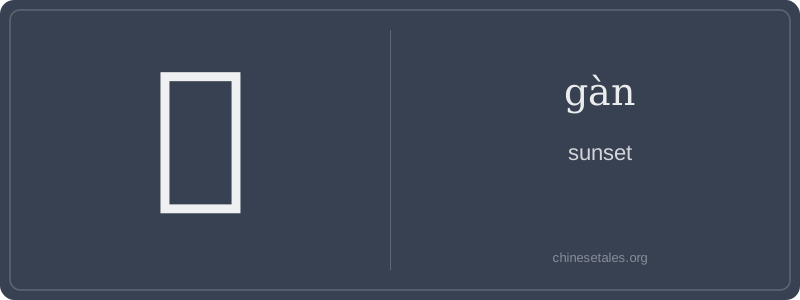
The earliest form of 旰 appears in bronze inscriptions as a compound pictograph: 日 (sun) on the left, and 旱 (hàn, 'drought') — originally depicting a man kneeling under a blazing sun — on the right. Over centuries, 旱 simplified into 干 (gān), losing its 'man' component and retaining only the 'sun-dry' essence. By the seal script era, the right side had stabilized as 干, visually echoing both phonetic similarity (gàn/gān) and conceptual resonance: the sun at its most intense, then beginning its descent — the critical transition from zenith to twilight.
This evolution reflects how ancient Chinese observed time through celestial labor: 'sun-干' didn’t mean 'dry sun,' but rather 'the sun when its heat begins to relent' — the precise turning point before evening. In the Book of Documents and Tang poetry, 旰 appears in phrases like '日旰忘食' (rì gàn wàng shí), describing rulers so absorbed in governance they forget meals until sunset — turning a simple time marker into a moral emblem of devotion. Its shape, therefore, isn’t just visual shorthand; it’s a fossilized moment of bureaucratic timekeeping, frozen in ink.
Think of 旰 (gàn) as Chinese literature’s ‘golden hour’ — not the Instagram filter, but the ancient, poetic moment when the sun dips behind the horizon and imperial courtiers finally exhale. Unlike common time words like 晚 (wǎn, 'evening') or 夕 (xī, 'dusk'), 旰 carries a quiet, almost reverent weight: it evokes the late afternoon light slanting across palace rooftops, signaling the end of official business. It’s not used in daily chit-chat — you won’t hear it ordering takeout — but appears in classical phrases and formal writing to add elegance and temporal precision.
Grammatically, 旰 is almost always a noun or time noun modifier, never a verb or adjective. You’ll see it in fixed expressions like 日旰 ('sun-旰', i.e., 'when the sun has declined'), or paired with verbs indicating delay or exhaustion: '日旰未食' (rì gàn wèi shí) — 'The sun is low, yet they haven’t eaten.' Note: it never stands alone as 'sunset' in isolation like 落日 (luò rì); it’s inherently relational — always tied to an event’s timing or a person’s fatigue.
Culturally, learners often misread 旰 as 'dry' (gān) due to identical pronunciation — but there’s no semantic link. Worse, some mistakenly pair it with modern time markers (e.g., *今晚旰), violating its classical register. Its rarity outside literary contexts means even advanced learners may encounter it first in Tang poetry or historical dramas — where it subtly signals austerity, duty, or the passage of time under imperial scrutiny.