旡
Character Story & Explanation
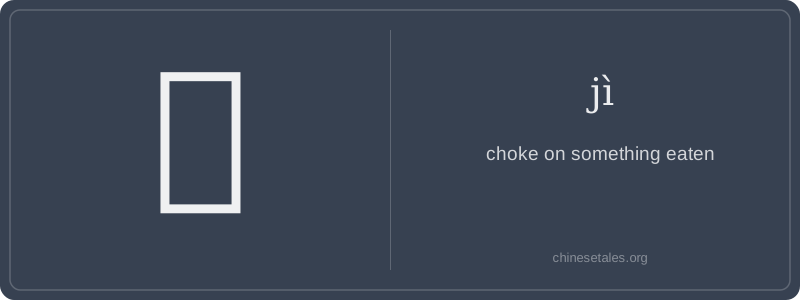
The earliest form of 旡 appears in oracle bone inscriptions as a stark, vertical glyph: a simplified head with a downward-curving line cutting across the neck—no mouth, no open jaw, just a clean, unbroken arc sealing the throat. Over centuries, the head became a dot (the top stroke), the neck a vertical line (second stroke), and the constriction evolved into two connected horizontal strokes (third and fourth), forming today’s compact, boxy 旡—four strokes, zero ambiguity: a body shutting down airflow from within.
This pictograph wasn’t about choking *accidentally*—in Shang dynasty ritual context, it likely depicted ritualized breath-holding or the cessation of voice during sacred silence. By the Warring States period, it appeared in texts like the *Zhuangzi* describing states of 'speechless awe' (旡言) before the Dao. Its meaning never broadened; instead, it narrowed into a precise technical term for *physiological or metaphysical blockage*. Even Confucius used 旡 not to scold bad table manners—but to name the exact moment when moral clarity is choked off by desire.
Think of 旡 (jì) as Chinese’s linguistic equivalent of that universal, cringe-inducing moment when you gulp down food too fast and suddenly—*gack!*—you’re mid-choking, eyes watering, hand flying to your throat. It doesn’t mean 'hungry' or 'eating'—it’s the precise, visceral instant *after* swallowing goes wrong: the airway blocked, breath cut off, a silent, panicked freeze. This isn’t a verb you’d use in daily conversation like 'eat' or 'drink'; it’s literary, archaic, and deeply physiological—capturing not just physical obstruction but also metaphorical suffocation (e.g., suppressed emotion, stifled speech).
Grammatically, 旡 functions almost exclusively as a stative verb or adjective in classical texts—and crucially, it’s nearly always used in negative constructions like 旡聲 (jì shēng, 'voiceless') or 旡言 (jì yán, 'speechless'), where it conveys an *absence caused by blockage*, not mere lack. Learners often misread it as 'already' (like 已 yǐ) or confuse its top stroke with the radical for 'mouth' (口 kǒu), but 旡 has no mouth—it’s a closed-off throat. You’ll almost never see it alone; it’s a semantic building block, not a standalone word.
Culturally, 旡 appears in early medical texts and Daoist writings describing breath control and qi stagnation—and its visual austerity mirrors its meaning: minimal strokes, maximal tension. Modern learners rarely encounter it outside classical study or compound words, so mistaking it for similar-looking characters is the #1 error. Remember: this character doesn’t describe hunger—it describes the terrifying, breathless pause *between bite and breath*.